When a Cracked Driveway Needs a Tear-Out Instead of a Patch
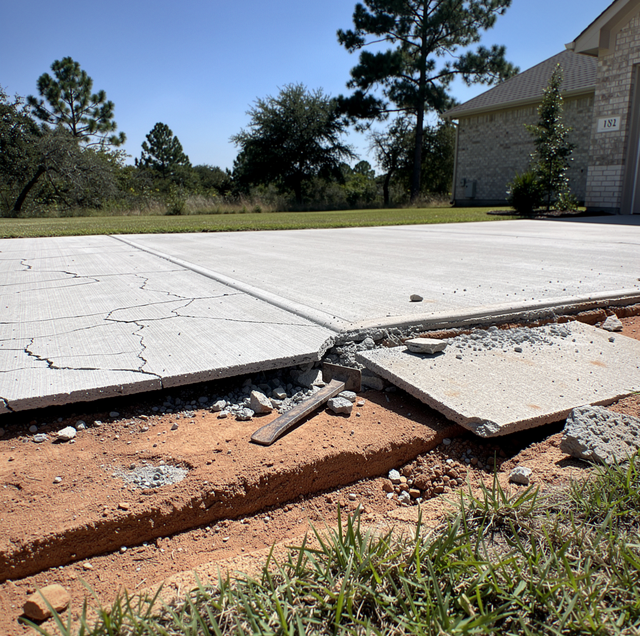
At some point, the decision already got made. The cracks, the settling corner, the panel that no longer sits where it used to did that: the driveway is getting fixed, one way or another. What remains open is how far the work goes: whether one failed stretch of concrete is replaced with a fresh panel, or the whole slab is removed and started over from the base.
That question has a real answer. What decides it is the driveway itself, read one panel at a time.
What a surface patch accomplishes: It fills the visible crack. It does not get to the reason the crack opened, whether that's a base that moved, settled, or wasn't compacted evenly. A patch bonded over ground still moving underneath tends to reopen along the same line within a season. A surface patch is also not work a concrete contractor who rebuilds driveways takes on, because it does not fix anything: the choice worth making is between replacing the failed panels and replacing the slab.
What the Crack Has Already Told You
Two readings usually happen before anyone talks about scope, and most of the time both have been made already.
Flush or stepped: Whether the surfaces on either side of the crack still sit in one plane, or one panel has dropped below the one beside it.
Still opening or stopped: Whether the crack is wider than it was a season ago, checked against a mark scored across it, or has held one width through a wet stretch and a dry one.
Those two answers are the inputs to everything below. A stepped crack still opening says the ground under one part of the slab is doing something the ground under the rest is not, and new concrete set on that ground answers to it the same way the old panel did. Flush and holding says the slab has relieved its stress and settled into a position it is keeping.
Neither decides how far the work goes. Three things do: how much of the driveway shows the same condition, what the concrete reports once it is out of the ground, and whether anything under it is still growing.
How Much of the Slab Is Involved
Scope isn't only about how bad one crack is. It is about how many places on the driveway show the same thing, and how they sit relative to each other.
An isolated failure: One panel, or one corner, in a slab whose other panels are flush, quiet underfoot, and holding their joints. The condition under that panel is local: water that pooled in one spot for years, compaction that ran thin where the base was hardest to reach with a plate, and a utility trench backfilled loose and never brought up to the density of the surrounding soil.
A repeating pattern: Several panels cracking, settling, or sounding hollow, spread across the driveway rather than clustered in one place. Spread is the word doing the work. A cluster points to one spot where something went wrong during the build; failures at the street end, in the middle, and up by the garage all point to the base beneath them, and the panels, still flush today, sit on that same base.
Hollow is worth learning to hear. A panel in full contact with what is under it sounds dull and short, while one that has lost its bearing sounds like a drum under a heel and feels faintly loose underfoot. That panel can be sound concrete and still have to come out, because what needs correcting is beneath it rather than in it.
Some of what a driveway shows is not a scope question at all, and reading those keeps a job from growing unnecessarily.
| What You See in the Driveway | What It Points To |
|---|---|
| A crack that runs along an existing control joint | The joint doing the job it was cut to do, not a failure |
| A hairline crack with no step, holding one width through a full wet season and a dry one | Movement that has settled out for now; continued watching beats acting on it |
| One panel lifted along a line that runs back toward a mature tree | A root under that panel, which changes what the fix includes rather than how large it is |
What the Broken-Out Concrete Reports
A failed panel isn't replaced until the ground beneath it has been opened up and inspected, because new concrete set on uncorrected ground gets the same treatment as the old panel. What the crew finds down there decides how much of the base comes out, and the panel does not get poured until that material is back to something stable and uniform.
The useful evidence is what the demolition itself produces, which nobody has until the first panel is out.
A washed-out or poorly compacted base: The underside comes up dirty and irregular, aggregate knocking free from the bottom face under a hammer, and the ground below it loose and uneven where water has been running along under the slab.
A panel that cracked from shrinkage or load alone: The break runs clean and dense straight through, the underside is a flat cast of the ground it sat on, and that ground takes a boot heel without rutting.
That difference sets the next step. Ground in the first condition gets undercut and rebuilt in compacted lifts before concrete is ordered. Ground in the second was sound all along, and the concrete simply reached the end of what it could carry. It is also where a job scoped as one panel occasionally grows, and where one scoped as a full replacement occasionally shrinks.
Breaking out and removing cured concrete is heavy-equipment work. Slab sections are heavy, edges shatter unpredictably under a breaker, and cutting or breaking concrete releases fine, respirable silica dust. This is not a homeowner task.
Roots change what the fix has to include. A root pushing up from underneath doesn't just crack the panel above it; it keeps growing after the crack opens, so a new panel poured over the same root heaves again on roughly the same timeline as the last one.
Cutting a large structural root to free a heaved panel can take away part of what holds a mature tree upright. Which roots can be severed, and which cannot, is a question for an arborist before the saw comes out.
Replacing by the Panel, and Where the New Joint Lines Land
Once the failed area is isolated and the ground under it is sound or corrected, panel-by-panel replacement becomes reasonable there. This is not a patch. The failed concrete comes out completely, down to the base, and new concrete goes back at full depth with the reinforcement the rest of the slab carries. What decides whether it reads as a clean job is where the new joint lines land.
New joints on existing lines: Replacing a panel along its original control-joint layout keeps the driveway's structural pattern intact and gives the new concrete somewhere designed to crack. Where the failed area does not line up with that layout, the new joints cut across old panels, which usually means accepting a joint pattern that reads slightly different from the rest.
The part worth knowing before choosing this option: new concrete poured beside older flatwork will not match it. Color and surface texture drift with age, sun exposure, and the batch used, so a new panel set beside weathered ones reads lighter and has a different finish from day one. The two surfaces don't converge with time either; a partial replacement leaves a visible line in the driveway permanently, in a way a full repour does not. That is a real tradeoff in the smaller job, worth weighing against the sound concrete it leaves in the ground.
What a Full Replacement Changes That a Partial Never Can
A full tear-out removes every panel and starts the base from scratch across the whole footprint, not just the failed section. That matters most when several panels show the same failure, which points to a base condition under the entire driveway rather than a single bad spot. Correcting the base once, under the entire slab, means every new panel cures as one uniform surface: same color, same finish, same age, with no seam where new meets old.
It also opens the door to design changes that a partial replacement can't reach, because the whole area is open at once rather than a single isolated section. None of that makes a full replacement the better call by default. It is a larger scope, warranted where the base problem, or the amount of failed concrete, reaches that far.
A small, isolated, dormant crack rarely earns a full tear-out, and a driveway failing the same way across most of its panels rarely gets fixed by replacing the worst one. Whichever description matches what is in front of you sets the scope.
Frequently Asked Questions
Not necessarily. Where the layout allows, a driveway can be broken out and poured in sections rather than all at once, so part of it remains usable while another section cures. Whether that's practical depends on the driveway's width and how much of the slab needs to come out.
Depending on volume and site access, removed concrete is sometimes crushed on-site and reused as compacted fill elsewhere on the property rather than hauled away whole. Other times, on a tight lot with no place to stage it, it is loaded out entirely. Either way, it doesn't go back under the new pour in its broken form.
A decorative overlay applied across the entire driveway, not just the new section, is the only way to visually unify old and new concrete once a partial replacement is in place. It is a separate scope from the repour, applied afterward across the whole surface rather than one panel.
A root barrier, a rigid panel set vertically along the cut line at the time of the repour, is what keeps the next root out of that space. Removing the root alone does not. The barrier goes in while the ground is still open, since adding one afterward means excavating the same line a second time.
Width, drainage slope, and the position of the control joints are the three things that can change, and all three stay fixed once one panel goes back inside an unchanged layout. A driveway re-sloped to send water away from the garage, or widened at the apron, is a decision made while every panel is out of the ground.
A penetrating sealer or a cleaning treatment is what surface staining calls for, and neither is a scope a contractor who removes and repours slabs sells. Discoloration is on the top surface of concrete that is otherwise sound and holding its plane, so there is nothing structural beneath it for a tear-out to address.
Read in that order: the crack first, then how far the same condition spreads, then what the concrete reports once it is out of the ground. A question that felt like a guess turns into one grounded in what the slab is doing. That is the difference between a fix that holds and one that defers the same decision to next season.
Get an honest read on your driveway — a walk-through that tells you plainly whether one section can be replaced or the whole slab needs to come up, with no pressure toward the bigger job. Palacios Construction Group serves Willis, Conroe, and The Woodlands, from driveway replacement in Pinehurst to well-drained driveways in Spring. Call (936) 828-8664.
