What a Properly Compacted Base Does Under a Driveway Slab
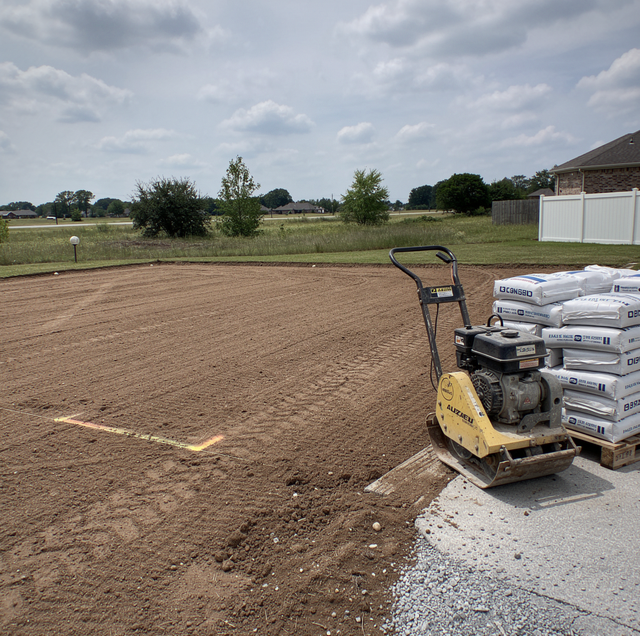
On a driveway job, the first truck to arrive isn't the mixer. Before any concrete is ordered, trucks haul soil off the site and haul in different material: a driveway of ordinary size moves more material out and back in than the concrete that eventually sits on it. Out goes soil that can't be trusted to hold a slab flat; in comes material engineered to. Standing on site at the end of day two, it can look like nothing happened: no forms, no rebar, just a graded strip of ground the same color it started as.
That invisible stage decides more about how your driveway performs over its whole service life than the concrete mix does. A slab is a thin, rigid sheet poured over whatever is underneath it, and it can only be as flat, as stable, and as long-lasting as that ground.
The Material That Has to Leave First
Topsoil can't carry a slab. It's full of old roots, decayed leaves, and grass, and that organic matter breaks down over years, leaving small voids in the ground that used to be solid. A slab poured on that ground settles unevenly as those voids collapse, one small pocket at a time, long after the crew has moved to the next job.
Under the topsoil, the next few feet of native ground are often plastic clay that swells when wet and shrinks when dry. That movement is real, and it's the reason a slab needs a stable base at all, but the clay itself is a different subject; this piece is about what the base does about it. What matters for the base is that stripping goes deep enough to reach soil that isn't full of decaying organics and isn't loose fill from an old grading job, a removed tree stump, or buried debris nobody remembers.
Ground that's already stable: How deep the stripping goes is a read on what is actually there, not a fixed depth applied everywhere. Ground that has been graded, compacted, and driven on for years; a former parking pad; a yard that has carried heavy equipment without shifting; competent mineral soil that is already dense can stay where it is and be compacted in place. What comes out is what fails that read.
Gas, electric, water, and irrigation lines often run shallow across a residential lot. Before excavation for base prep starts, those lines get located and marked, and digging stays clear of them.
Moisture Decides Whether Compaction Works at All
A compactor presses soil particles closer together until they lock against each other, and that only happens in a narrow moisture range. Soil that's too dry stays loose and crumbly no matter how many passes a compactor makes, because there isn't enough moisture to help the particles slide into place; a compactor left running on ground like that just polishes a dry surface instead of densifying it. Soil that's too wet does the opposite: instead of compacting, it turns plastic underfoot, and the compactor's weight pushes water and soil sideways rather than pressing them down. Crews call this pumping, and a boot planted on ground like that will feel it flex and give.
The way a crew checks moisture in the field is a hand test, not a gauge. A handful of soil squeezed into a fist should hold its shape as a loose ball and break cleanly in two when snapped. Soil that won't hold that shape is too dry, and water gets worked into the ground before rolling starts. Soil that smears wet across a palm and leaves it slick is too wet, and it gets turned over and left to dry, sometimes for a full day, before a compactor touches it. Getting this right before the first pass determines whether every pass after it does any good.
Compacting in Lifts, Not All at Once
A compactor's energy only reaches so far into the ground. Dump two feet of loose fill at once, run a compactor over the top, and the surface densifies while the material several inches down stays exactly as loose as it was when dumped. That hidden loose layer settles later, under the weight of the slab, the same way ground that was never compacted at all would settle, just delayed by however long it takes for that weight to find the soft spot.
That's why base material and fill go down in lifts, a few inches at a time, each one compacted before the next lift goes on top of it. It's slower than dumping the full depth and rolling it once, and it's also the only way a compactor's limited reach can treat the whole depth of material instead of just the top.
Compaction itself is measured, not eyeballed. A lab test on a sample of the soil, commonly called a Proctor test, establishes the maximum dry density that soil can reach at its ideal moisture content, and field compaction gets specified as a percentage of that number, with 95 percent of the standard Proctor maximum the figure most commonly written into residential specifications, rather than as a fixed count of passes with a machine. Two lifts can look identical on the surface and still differ by several percentage points in actual density.
A Base That's Strong Everywhere, but Uneven Still Fails
A slab doesn't bend to match small differences in what's underneath it; it's a stiff, largely unbending sheet spanning whatever support it has. Where that support is uniform, the slab carries the load as it was designed to. Where it changes abruptly, firm ground on one side of a line and a softer pocket a few inches lower on the other, the slab has to bridge that difference on its own, and a rigid material bridging an inconsistency eventually cracks right along the line where the support changes.
This is why a base can pass a compaction test at several spots and still fail the driveway above it. A pocket with fewer passes than the surrounding ground, a low corner a compactor operator couldn't fully cover against a form, an old root ball that decayed after grading: none show up as failed tests if the test points land elsewhere. Uniform density across the whole footprint matters as much as any one target number.
There is a limit built into that check, and it is worth naming plainly. A density test reports the density at the spot the probe went into and nowhere else. A base can come back with a passing number at every point tested and still hold a soft pocket between two of them, and that is a limit of the verification itself rather than something more dirt work solves. It is why where the test points land, and how many of them there are, gets as much attention from a grade crew as the numbers they return.
The Base Course Itself
The material over the compacted subgrade generally isn't a re-compaction of the dirt that came out of the ground. It's engineered, most often crushed limestone base or recycled crushed concrete, brought in because it's manufactured to a controlled gradation rather than whatever mix of clay, sand, and organics existed on-site. That gradation locks together tightly under compaction and drains, instead of holding water the way native clay does.
This base course carries the slab's load directly and spreads it out over a wider area of subgrade below, which is part of why an uncompacted or thin base fails even when the concrete above it is a good mix. The base's job is to take the point loads a slab experiences, a parked truck's tires, a trailer jack, and spread them out before they reach the native soil underneath.
What the Base Hands Off to the Reinforcement Above It
Rebar-reinforced, 3,000+ PSI concrete on a properly compacted base is the standard build for a reason: each part has a narrow job, and each one assumes the part below it did its own. Rebar does its work only where the ground on both sides of a crack is equally solid. The mix and its strength rating govern how much load and wear the cured surface takes. Neither one includes bridging a soft spot in the base.
Asking a rebar grid to hold up a slab spanning an uncompacted pocket is asking it to perform structural work it was never sized for. What the base hands up is a condition rather than a load path: either every foot of the slab is bearing on ground of the same stiffness, or some of it is not. Steel and mix strength both behave differently in those two conditions, and neither one gets to choose which condition it works in. That gets settled by the grade crew before the first length of rebar is tied.
Frequently Asked Questions
With a nuclear density gauge, which reads density in place by driving a probe into the compacted lift, or with a sand-cone test, which weighs the material dug out of a small hole and measures the volume of calibrated sand required to refill it. Each returns a pass or fail against the lab-determined maximum for that soil.
Most often, a crushed limestone base is graded from roughly three-quarter-inch stone down through fine particles, so the coarse and fine material locks together tightly when compacted. That mix of particle sizes, not just the rock itself, is what lets it compact hard and still drain.
Commonly four to six inches of compacted base material over the prepared subgrade, separate from the concrete slab thickness above it. That figure is a general baseline; soil conditions and expected loads can call for more.
On sites with soft or silty native ground, a geotextile separation fabric goes down between the subgrade and the base rock. Without it, base rock and soft native soil can intermix under repeated loading over the years, and the base loses the controlled gradation that made it work.
Yes. A vibratory plate compactor handles shallow lifts and tight spots close to forms and edges, where a larger machine can't maneuver. Thicker lifts across open ground call for a heavier trench roller or ride-on roller, matched to the compacted lift depth rather than a single machine for the whole job.
Proof-rolling: driving a loaded truck or a heavy roller slowly across the compacted base immediately before forms and rebar go in, watching for rutting, pumping, or visible flex. It goes last, after the density numbers are already in hand, and if rain falls between the testing and the pour, the pass is repeated rather than the density test.
A base is not judged by how much material went into it. It is judged by whether every square foot of it behaves the same as the square foot beside it, because a slab ends up only as flat as the least consistent part of the ground it landed on. That consistency is the entire product of the days before the pour.
Talk through the base prep on your site — a walk of the grade before anything gets ordered will show how much of the ground needs to change and how much already works. Palacios Construction Group serves Willis, Conroe, and The Woodlands, from long rural driveways in Tomball to boat and RV pads in Montgomery. Call (936) 828-8664.
