French Drains and Grade Before Anything Gets Poured
Rain lands on the roof first. It runs down the slope of the shingles into a gutter, gathers there, and drops out through a downspout at one corner of the house, then another at the opposite corner. A roof that would otherwise shed water evenly across its whole surface concentrates all of it into two or three small, fast streams landing in two or three small spots.
From there the water crosses a narrow strip of dirt or mulch against the foundation, spreads across the grass if the grade lets it, and keeps moving until the ground stops accepting it. In an ordinary yard, usually a low corner, a fence line, a spot behind a shed, or the back third of the lot where the slope runs out. It sits. It soaks in over the next day or two, or it finds a ditch and leaves. None of that sequence involves concrete yet.
A Roof Sends Its Water to a Few Small Spots
The roof's share: A house with an ordinary-size roof sheds a large volume of water off a hard surface every time it rains, and almost all of it exits through as few as two or three downspouts. That means the patch of ground under each one takes a disproportionate hit compared with the rest of the yard, storm after storm, year after year. How quickly that water clears the gutter and where it lands depend on the gutter system's sizing and pitch.
What matters for everything that follows is simple: by the time water reaches the ground, it's arriving at a few concentrated points, not spread across the yard, and whatever happens next starts there.
The Ground Against the House Has One Job
The strip against the house: The first few feet of ground around the foundation exist to carry that concentrated water away from the house, not to hold it and not to tip it back toward the slab. Ground that is flat across that strip, or that settles into a shallow dish over time as soil compacts unevenly, does the opposite of its job. Water sits against the foundation instead of leaving and softens the soil under the footing on a wet-dry cycle. On expansive clay, the same wet-dry cycle cracks a driveway poured without adequate reinforcement.
Fixing this strip usually means moving soil, not adding pipe. Regrading a few feet of dirt so it falls away from the house solves more of this than anything buried in a trench, and it's usually the first thing worth doing.
Where the Yard Flattens Out, the Soil Pays for It
Past that first strip, most yards flatten out. Once the ground goes close to level, gravity stops doing much work, and water that used to keep moving now just sits until it evaporates or soaks in on its own schedule.
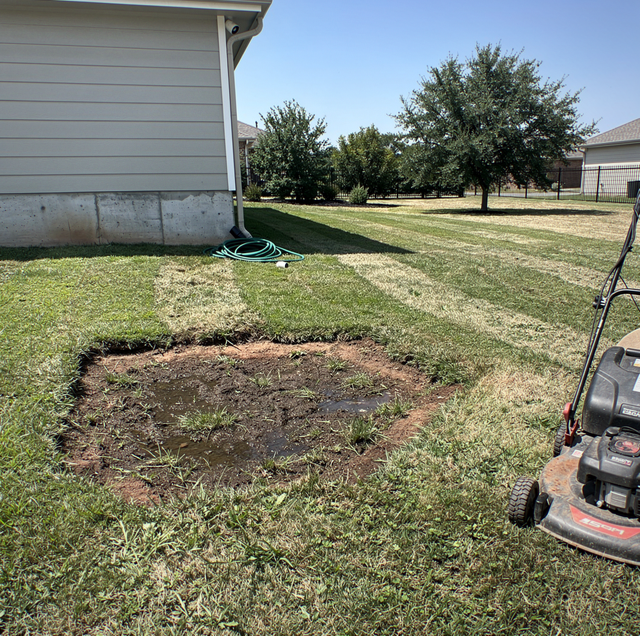
The flat stretch: Two days after a hard rain, that low spot is still readable from the back door. The grass over it sits a shade darker than the lawn around it and lies flatter, still holding the shallow ruts a mower left behind, while the ground ten feet away has dried on top and stood back up.
That saturation doesn't stay harmless. Soil that holds water for days instead of hours compacts differently under foot traffic, drains poorly the next time because it never fully dried from the last one, and thins the grass to bare, soft dirt. If that low spot happens to sit within the footprint planned for a new patio or driveway, the ground about to carry a poured slab is ground that is saturated for part of every season. That's the condition a French drain is built to change.
What a French Drain Collects, and What It Can't
Physically, a French drain is a trench dug along the path water is already moving through the soil, with a slotted pipe laid in the bottom and bedded in coarse gravel, running downhill by whatever fall the yard has. What the pipe collects: Water already saturating the soil around the trench works its way through the gravel and into the slots, then travels inside the pipe to wherever the run ends. It is collecting groundwater moving below the surface, not stopping rain in the air or catching a downspout's stream directly, which is handled at the gutter and at the grade around the foundation instead.
What it can't: A French drain does little for water still moving fast across hard, flat ground that never has time to soak in before it is three yards away. That's a surface problem, and it needs a surface fixture, a shallow channel or a swale cut to carry that sheet flow somewhere useful, not a buried pipe that water underground would have to find its way down to first.
An open trench along a foundation is a fall and cave-in hazard, and one left open during a storm fills faster than it drains, turning a shallow cut into standing water overnight. Keep runs short, sloped, and backfilled quickly.
This part is worth naming honestly. A French drain is a maintenance item with a service life, and selling it as a permanent fix is overselling it. Fine soil works into the gravel and through the slots a little at a time. A tree root finds the trench because the trench is the wettest, loosest ground available to it. A run laid under a spot where a truck or a trailer ends up parked can be crushed by a load nobody planned for. And a run that nobody ever flushes eventually stops being a drain at all and goes back to being a trench full of gravel with a pipe in it.
Before backfilling a new run, flush it with a hose from the high end and confirm water reappears at the outlet within minutes. It is the check that cannot be repeated once gravel covers the pipe.
The Discharge Point Decides Everything Upstream
The outlet: None of the trench, pipe, or gravel matters if there is nowhere for the water to go. A French drain moves water by gravity: the far end of the run has to sit lower than where it started, or nothing drains at all without help. That's a physical limit: water still has to travel downhill to leave, and it has to end up somewhere that does not simply hand the same water to whatever's next door.
On a lot with a clear low corner or an existing ditch, that outlet is easy to find, and the whole design falls into place around it. On a flatter lot, or one where every low point already belongs to a neighboring yard, finding a workable place to send that water is the constraint the rest of the design has to bend around, and it gets solved before the trench gets dug, not after.
What Changes Once the Patio or Driveway Goes Down
Under the slab: A patio or a driveway doesn't remove the water that used to cross that ground; it just changes how fast it moves and where it goes. Concrete sheds rain almost immediately instead of letting it soak in, so the same storm that used to spread its runoff across open soil now delivers it, faster and more concentrated, to whatever edge the slab drains toward. If that edge is the same low spot a French drain would have used as its route, the order matters: drain first, then pour.
Once the concrete is down, correcting a drainage mistake underneath it means cutting into new work to fix a problem that was a morning's excavation while the ground was still open. The properly compacted base under a new slab carries the slab once it is poured; routing the water correctly happens before any of that gets built.
Frequently Asked Questions
Not necessarily, and sometimes the opposite. A pipe fitted with its own fabric sock resists fine soil migrating in from the sides better than a trench where fabric wraps the whole gravel bed, because sediment can work into that outer layer from outside over the years and choke it before the gravel itself clogs.
No, and the difference is where each one sits. A curtain drain is placed uphill of a structure to intercept water moving toward it before it ever arrives, while a French drain built along a foundation collects water right at the wall itself, after the water has already reached the property's low side.
When a lot has no usable low point or ditch to run to, the answer becomes mechanical instead of gravity-fed. A sump basin collects water at the low end of the run, and a pump lifts it to a surface discharge, or a dry well is dug to hold and slowly release what the soil alone can't absorb fast enough.
It depends on whether a clean-out was built into the run in the first place. A vertical inspection port set at the high end of the pipe allows a hose or a small jetting nozzle to flush the line from above, clearing most blockages without ever reopening the trench.
More often than expected, it is whatever is already buried nearby. Established tree roots and existing irrigation lines can force a run several feet off the straightest path, since cutting through either one creates a second problem while solving the first.
By what comes out of the outlet, not just by whether anything does. A run that is working discharges water that clears up after the first minute or two of flow. An outlet that keeps producing muddy water storm after storm is carrying soil fines out of the trench along with the water, and a line moving fines is silting itself shut from the inside while it still looks like it is draining.
Get the drainage question answered while the yard is still open dirt. Water leaves a lot by one route, or another, whether anybody chose that route or not, and the only thing a project settles is whether somebody picked it before the concrete did.
Get the drainage settled before the concrete — regrade the yard and route a French drain as part of the same project, so the water's path is already solved before a patio or driveway goes down over it. Palacios Construction Group serves Willis, Conroe, and The Woodlands. Call (936) 828-8664.
