Why Concrete Driveways Crack on Houston-Area Clay
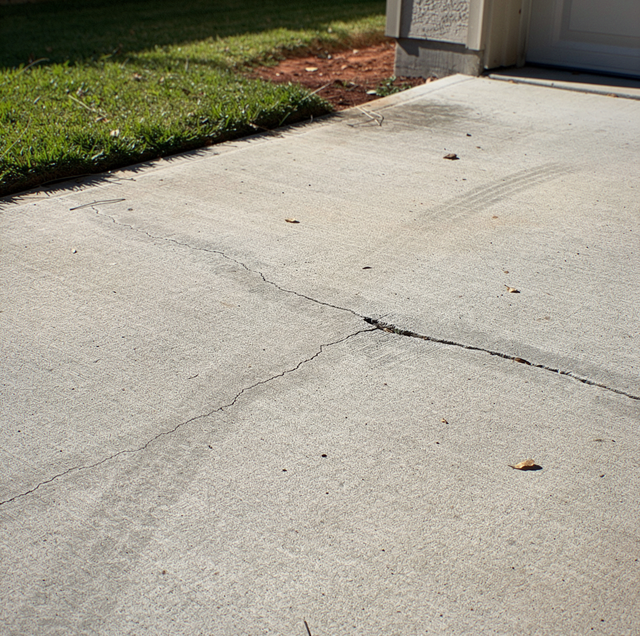
You walk out to the driveway on an ordinary morning, and there it is: a crack running corner to corner that wasn't there when you mowed last weekend. The front tire of your car gives a soft thump every time you pull in, right where the slab has dropped a fraction on one side of the line. Nothing hit it. Nobody backed a trailer over it. It just showed up, and once you've noticed it, you notice it every time you pull into the driveway.
What Expansive Clay Does Beneath a Slab
Under nearly every driveway that develops this kind of crack, the soil is clay, and clay behaves differently from most other soils: it changes volume with moisture. The fine mineral particles that make up clay pull water in between their own layers when the ground is wet, and the whole mass expands. When a dry stretch follows, that water leaves and the clay pulls back and shrinks, sometimes opening into a rough network of surface fissures you can see in a bare patch of yard nearby. A slab of concrete poured directly on top of that material rides every one of those swings. It doesn't move on its own; it moves because the ground under it moves, up when the clay is saturated and down when it dries out, and it keeps doing that every wet season and every dry stretch for as long as the slab is there.
In hot climates with heavy seasonal rainfall, that cycle repeats hard and often, which is why clay-related cracking shows up far more on this kind of soil than on sand or a well-drained site. The same swelling and shrinking also heaves fence posts and can tip interior floors out of level elsewhere on a property, driven by the same movement underground.
Why That Movement Reaches the Concrete at All
A slab doesn't have to move very far to crack, because concrete has almost no ability to bend. It's strong when you push or stack weight on it and weak when you try to stretch it, so when the ground underneath drops on one side of a panel and stays put on the other, the slab is effectively asked to span that gap on its own, something a plain, unreinforced pour was never built to do.
Where clay pulls away from the underside of a slab entirely, during a dry stretch, the concrete loses its support and has nothing under part of its own weight but air. The first vehicle that crosses that hollow section, or sometimes just the slab settling under its own mass over time, is what turns a soil problem you couldn't see into a crack you can.
Three Decisions Made Before the Truck Shows Up
Whether a driveway shrugs off that kind of ground movement for decades or starts cracking within a year or two gets decided before a single yard of concrete arrives, in three separate decisions.
Subgrade preparation: The soil under the slab must be excavated, brought to the proper moisture content, and compacted in stages so it settles predictably rather than unevenly later. A base built up in one thick lift can test firm at the surface and still consolidate unevenly underneath, which is how a slab loses its bearing in patches rather than all at once.
Reinforcement: Steel inside the slab doesn't stop concrete from cracking. It holds the two sides of a crack together so the crack stays tight and the panel keeps carrying load instead of one edge dropping below the other. That is why a rebar grid is tied and set up on chairs so the steel rides in the body of the slab, not lying on the ground at the bottom of the pour, where it does little to resist the tension the slab sees when the ground drops away beneath it.
Joint layout: Concrete is going to shrink and crack somewhere as it cures, and control joints exist to decide where that happens on purpose instead of at random. Joints cut too shallow, or cut too long after the pour, let the slab find its own line first and crack alongside the joint rather than in it.
Get those three right on clay, using rebar-reinforced concrete at 3,000-plus PSI poured over a properly compacted base, and the slab moves with the ground instead of fighting it. Skip any one of them to save time on the front end, and the ground eventually finds the weak point for you.
Reading the Crack You Already Have
If a crack has already shown up, you don't have to guess blind about what it means. Three things tell you most of what you need to know: how wide it is, whether one side sits higher than the other, and what shape it takes across the panel.
A hairline crack running in a fairly straight line, especially one that lines up with or extends an existing control joint, is usually the concrete doing exactly what it was built to do: relieving shrinkage stress along a planned line rather than a random one.
A crack you can't fit a fingernail into is usually cosmetic. One wide enough to catch a house key, or with a noticeable lip, is worth a second look.
An offset crack, where you can feel that lip between one side and the other, is a different signal. That isn't the concrete shrinking; it's one side of the slab resting on ground that's higher or lower than the ground under the other side, which is soil movement, not curing. A crack that wanders, branches, or crosses a control joint at an angle rather than following it is also worth closer attention, because it suggests the ground moved unevenly enough to override the joint layout meant to control where cracking occurred.
Cosmetic Damage or a Structural Problem
Not every crack on clay is bad news. Shrinkage cracking is normal and, on its own, not a sign of a bad pour or a failing driveway. Concrete cracks; that's part of how the material behaves as it cures and ages.
A crack becomes more than cosmetic when it comes with company: when more than one panel shows the same offset, when a section has tilted enough to redirect rainwater toward the garage or the house instead of away from it, or when the crack keeps widening season after season instead of settling into a stable width after the first year or two. Any one of those means the ground is still moving, and it's worth having someone look at the whole slab, not just the one crack you can see from the porch.
When to Stop Watching and Call Someone
A single tight, straight hairline crack that isn't growing is something you can reasonably keep an eye on. A driveway with multiple wide or offset cracks, standing water pooling against the foundation, or a section visibly out of plane with the rest of the slab has moved past the point where watching helps.
Deciding whether that means cutting out and repouring one panel or replacing the whole driveway is a judgment call, depending on how much of the slab has moved and how deep the cause runs. The unwelcome part of that answer often runs the other direction, though. A single tight hairline that has held the same width through several wet and dry swings usually needs nothing done to it at all. Not cut out, not repoured, not treated. Concrete that cracked once, relieved its shrinkage stress and then stopped is finished doing what it was going to do, and a slab in that condition does not need a contractor at all.
Buried utility lines must be located and marked before any tear-out or excavation begins. Saw-cutting cured concrete releases fine silica dust that requires proper respiratory protection, and removing and hauling a slab means operating heavy equipment that isn't homeowner work.
Frequently Asked Questions
Yes, in a specific way. A sprinkler head that consistently soaks the soil along one edge of a driveway and misses the other keeps the clay on that side wetter and more swollen than the rest, creating the same uneven support that cracks a panel. Even, consistent moisture around the slab does more good than cutting watering back everywhere.
Because a drying clay develops a vertical fissure network well below the surface, not only the cracking you can see in a bare patch of yard, and where one of those runs under a driveway it can telegraph straight up through the slab as a matching crack. Trees make it sharper still: a mature root system pulls moisture out of one zone far faster than the open yard dries, so the slab over that root zone loses its support first.
It can be either, and age alone doesn't tell you which. A slab sitting on an undersized or poorly compacted base can look fine for its first year because it hasn't yet experienced a large enough swing between wet and dry seasons to expose the gap. The first real cracking sometimes doesn't show up until the second or third cycle.
No. A joint is cut or tooled to roughly a quarter of the slab's thickness, so the concrete is deliberately weakened along that line and cracks there first. A crack out in the open field means the shrinkage stress found a weaker path than the one cut for it, which usually points to joints spaced too far apart for the slab thickness rather than to anything wrong with the concrete.
A flexible polyurethane sealant keeps rain and irrigation water out of the crack and away from the base material underneath, which is real but limited. It does nothing about the soil movement that opened the crack, so it slows water intrusion rather than repairing anything, and it is not what a slab that keeps moving actually needs.
No slab is finished moving, and the calendar is the wrong thing to watch. What matters is the shape of the swing rather than the season it falls in: clay worked by a saturated spell that reverses hard into a dry one moves more than clay drying gradually across a long, even stretch. A driveway that's looked stable for years can still show new movement the first time it takes a sharp reversal, so looking fine so far describes the weather it's seen, not the weather still to come.
A cracked driveway is rarely just about the driveway. It's a visible report on what the ground underneath has been doing for years, quietly, out of sight. The decisions that matter most- how the base was prepared, how the slab was reinforced, where the joints were planned- all happened in the part nobody gets to see once the concrete is down, which is usually where the real difference between a slab that lasts and one that doesn't gets decided.
Schedule a driveway assessment — get an honest read on whether your crack is cosmetic or a sign that the slab needs to be removed and repoured right. Palacios Construction Group serves Willis and Conroe, and repairs clay-cracked slabs from settled, cracked driveways in Klein to root-damaged driveways in The Woodlands. Call (936) 828-8664.
