Rebar Grid vs Wire Mesh in a Residential Concrete Slab
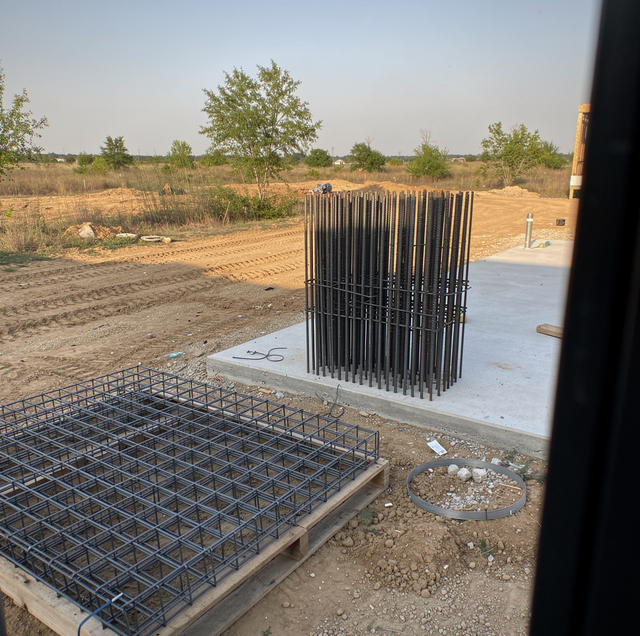
Two products are called reinforcement on a residential job, and on the morning of a pour, they lie on the same patch of dirt, looking nothing alike.
Welded wire mesh arrives as a coil banded with steel strapping or as flat sheets on a pallet: thin, smooth, cold-drawn wire welded at every intersection into a square grid. One person carries a sheet. Off the roll it will not lie flat, holding the curve of the coil until something weighs it down.
Rebar arrives as bundles of straight lengths, wire-tagged at the mill. The surface is not smooth: it carries rolled-in ribs along its entire length and a stamped mark naming the mill, the bar size, and the grade. Moving a length is a two-hand job, and the bar holds its shape across a span, which is why a tied rebar grid can be lifted at one corner and stay a grid.
That already tells you most of what each can do once it is buried. One holds a shape; the other has to be held, by somebody, until concrete covers it.
Reinforcement Is Not Crack Prevention
Hear this before the pour, not after. Concrete shrinks as it cures, and a slab on ground is restrained by friction against what it sits on, so the shrinkage has to go somewhere. It goes into cracks. Neither mesh nor rebar prevents that, and anyone promising a crack-free slab is selling something the material does not do.
Steel decides what a crack becomes afterward, which makes the real question how much tension each product carries across that line, and how reliably it stays at the depth where that tension shows up.
Soil movement makes it worse: Expansive clay swells when it takes on water and shrinks back when it dries, and the slab rides that movement either way.
Both products assume a base: Neither is a substitute for a properly compacted subgrade, and neither performs on top of a bad one.
What Each One Can Carry in Tension
Concrete carries compression well, and tension poorly, so cracks are tension failures. The useful question is how much tension each product carries across the line where the concrete has given up.
Rebar: Hot-rolled deformed bar, usually specified in Grade 60, where the grade number names the yield strength it is manufactured to in thousands of pounds per square inch. Bar sizes are eighths of an inch of nominal diameter, worth knowing when reading a quote: a #3 is three-eighths, a #4 is half an inch, a #5 is five-eighths. The published nominal cross-section of a #3 is 0.11 square inches and a #4 is 0.20, so one size up puts nearly twice the steel in a single bar.
Mesh: The standard designation looks like 6x6 W1.4/W1.4. The first pair is the grid dimension in inches. The W number is the wire's cross-sectional area in hundredths of a square inch, so a W1.4 wire is 0.014 square inches, against 0.20 for that #4 bar.
Mesh runs its wires closer together, so the steel in a strip of slab depends on the element and spacing, which is why grid dimensions are an engineering decision based on thickness, use, and soil conditions.
A fair correction: The wire itself is cold-drawn to a higher strength than a Grade 60 bar, so this is not a case of weaker metal. It is a question of how much steel crosses a given line, and whether that steel sits where the tension is. Bond differs as well: plain mesh wire grips mostly where the welded cross wires anchor it, while deformed bar grips along its entire length.
Where the Steel Sits in the Slab Thickness
Steel works only where the surrounding concrete is in tension, and that location moves. Where the slab bridges a soft spot, the bottom is in tension. Where it is propped on a high point or a tree root, the top is. Both exist in one slab, because support underneath is never uniform. The conventional answer is to hold the steel near mid-depth on chairs, ready for either condition. Held there, one bar answers both cases at once, which is what makes mid-depth a default rather than a split difference between two better positions.
Chairs and dobies: The grid is held up before the pour by plastic or wire chairs, slab bolsters, or the small concrete blocks the trade calls dobies, which are tied in so they cannot wander when the concrete arrives.
The mesh problem: Mesh is limp. It sags between supports, so holding it at a consistent depth takes far more support points than a stiff bar grid does, and one support kicked loose takes a whole span with it. Adjoining sheets also have to lap and be tied at the seams, because an unlapped seam is a line with no steel across it.
Ask for the reinforcement to be set, tied and supported before the truck is scheduled, then go walk it. Steel on chairs can be counted from the edge of the forms. Steel placed during the pour cannot be verified afterward.
What the Pour Does to Each Material
Placing concrete is not delicate work. Crews walk in it, buggies and wheelbarrows cross it, and whatever is under the surface is underfoot the whole time.
Walk a tied rebar grid before the truck comes, and the bars flex under your boot and come back up, chairs still under them. Walk a sheet of loose mesh, and it takes the print of your boot and keeps it.
Hooking: The old practice of pulling mesh up into wet concrete with a hook as the pour goes past does not do what it claims. The hook lifts the mesh where it is pulled and lets it drop either side, so the sheet ends up a wave running through the thickness rather than a plane at a chosen depth. Some land right; most do not, and nobody can tell which once the finishers are working.
Rebar fails less easily: the bar is stiff, the crossings are tied, and a grid that gets stepped on comes back.
Rolled mesh holds stored tension. Cut the bands only with the roll staked or weighted down, and stand clear of the ends, because a released coil snaps back hard enough to break a wrist.
Corrosion and Cover
Concrete protects steel both chemically and by burial. What defeats that is moisture and dissolved chlorides reaching it. The rust that forms takes up more volume than the steel it came from, and the pressure pushes the concrete above it off in sheets, which is why a sound-looking slab starts shedding flakes along a line.
Cover is the defense: The depth of sound concrete between steel and the nearest surface keeps water and salts off it. Steel at mid-depth has cover on both faces; steel at the subgrade has none beneath it.
The two lose ground at different rates. Mesh wire is a small fraction of the diameter of a #4 bar, so the same depth of corrosion takes a much larger share of a wire's cross-section. A mesh grid can be functionally gone, whereas a bar grid has lost its skin and still carries its load.
Where Each One Is the Appropriate Choice
Mesh is not a fraud. It is a lighter product for lighter work, and there are slabs it suits.
Mesh fits: Small foot-traffic flatwork on stable, well-drained ground with a good base under it. A short walkway, a shed pad, an equipment or condenser pad, a patio slab carrying people and furniture. Loads are low, and a crack that opens is cosmetic.
Rebar fits: Anything a vehicle drives or parks on, anything on soil that moves seasonally, any slab with an irregular shape or a long uninterrupted run, and any slab carrying something built on it, such as the posts of a covered patio or the masonry of an outdoor kitchen.
Most homeowners read this as strong steel against weak steel. It is closer to matched against mismatched: a driveway with mesh in it is underbuilt because the loads crossing it need more tension capacity, held at a controlled depth, than thin wire gives.
The Two Side by Side
| Question | Welded wire mesh | Rebar grid |
|---|---|---|
| What arrives on site | Rolls or flat sheets, smooth wire welded at the crossings | Straight deformed bar, mill-marked with size and grade |
| Steel in one element | W1.4 wire, 0.014 square inches | A #4 bar, 0.20 square inches |
| How it bonds | Welded cross wires anchor smooth wire | Rolled ribs bond along the full length |
| Holding position | Sags between supports, keeps a boot print | Holds a tied grid, springs back underfoot |
| After a crack forms | Holds a light slab tight where in position | Holds tension across the crack; halves keep working |
| Where it belongs | Light foot-traffic flatwork on stable ground | Drives, structures, moving soil |
The verdict: for a slab a homeowner pays for once, a rebar grid supported at mid-depth is the build worth asking for, alongside a 3,000-plus PSI mix on a properly compacted base. Mesh keeps a legitimate place on small, lightly loaded flatwork. What rarely survives is mesh placed badly, and that is the common case.
Frequently Asked Questions
Not into it. The one move at the boundary is doweling: drilling the edge of the existing slab and setting smooth steel dowels in a structural anchoring adhesive, so a new adjoining pour is tied to the old one and the two move together.
Synthetic micro-fiber targets plastic shrinkage cracking, the fine surface cracking that appears in the first hours while the concrete is still plastic and losing water to the air. What it cannot do is sit at a specified depth, since fibers are randomly distributed throughout the batch.
Annealed tie wire, commonly 16 gauge, twisted at the crossings with a tie twister using a snap tie or a saddle tie. Those ties hold position, not load: they keep the grid a grid while people walk on it, and carry no tension in the finished slab.
Yes, in one detail: bar where cracks are known to start, mesh in the field between. The classic case is diagonal bars at a re-entrant corner, the inside corner of an L-shaped slab, plus bars framing a block-out left for a post base.
Rarely. Those products are designed for chloride-heavy service, such as bridge decks, parking structures, and marine work, where salt constantly reaches the steel. There is a handling catch too: a coating protects only where intact, and a nick from a bar cutter concentrates corrosion there.
With a rebar locator, sometimes called a cover meter, which reads the steel electromagnetically and reports position and depth, or with ground-penetrating radar on congested work. Contractors use one before cutting or coring to avoid sawing through the steel. A magnet tells you that something ferrous is there, but nothing about how deep.
Mesh and rebar are not two grades of the same product. A scope that names one of them is describing a different slab, not a different word for the same one. What to ask for is the designation itself: the bar size and grid, or the mesh gauge and spacing, and how it will be held at depth. Written that way, the reinforcement stops being a promise and becomes something on the ground with a name.
Ask how your slab will be reinforced — get a written scope naming the steel, the grid, and how it will be supported before the pour is scheduled. Palacios Construction Group serves Willis, Conroe, and The Woodlands. Call (936) 828-8664.
