Concrete Driveway Installation & Replacement in Conroe and the Greater Houston Area
Your driveway is the first thing you see when you pull up to your home and the hardest-working slab on your property, carrying the weight of every vehicle, every day, through our brutal heat and shifting clay. Palacios Construction Group installs and replaces concrete driveways for homeowners across Conroe, Willis, the Lake Conroe area, and greater Houston. Driveways are part of our flagship concrete work, and we build them to last decades, not to crack in a few seasons. A failing driveway drags down the look of the whole home, and a good one quietly does its job for decades, which is why it is worth doing right the first time.
Why Driveways Are Built Differently Around Lake Conroe
The soil, the weather, and the lots in our area all shape how a driveway should be built. These are the realities we pour around.
Houston-Black gumbo clay
Willis, Conroe, Magnolia, and Spring all sit on expansive Houston-Black clay that swells and shrinks dramatically with the seasons. It is the number-one reason driveways crack and settle here. Proper base prep and reinforcement are not optional on this soil; they are the whole game, and they are exactly where we refuse to cut corners. The same soil that cracks a cheap driveway is no problem for one built correctly, which is the entire point of doing the dirt work and reinforcement right.
Drainage away from the garage and foundation
A driveway slopes toward the house more often than people realize, and when it does, every rain runs water toward the garage and the foundation. We set the grade so the driveway sheds water away from the home, protecting both the slab and the structure from the standing water our heavy rains bring. We check the existing fall on every replacement, because correcting a driveway that drains the wrong way is one of the most valuable fixes a repour can deliver.
Heavy rain and a saturated base
Our area sees well over 50 inches of rain a year, and gumbo clay holds that water. A driveway base that is not prepared and drained correctly turns soft and lets the slab settle. We prepare and drain the base so it stays stable through the wet-and-dry cycles.
Summer heat and pour timing
Local summers deliver long stretches of 90 to 100-plus degree days, and concrete poured into that heat can flash-set and finish poorly. We schedule driveway pours early in the day so the mix sets at the right pace and the surface finishes clean and strong.
Mature lots and tree roots
Established neighborhoods in Conroe, Willis, and Montgomery have large oaks and pines whose roots heave and crack driveways over time. On those lots, we plan the slab, joints, and edges around the root reality so the new driveway has the best chance of staying flat.
Long drives and acreage
Properties around Lake Conroe and out toward Magnolia and Montgomery often have long driveways and acreage approaches. These bigger pours reward careful base prep, drainage, and joint planning across their length, and they are exactly the kind of concrete work our flagship trade is built for.
RV pads and heavy vehicles
Boats, RVs, and trailers are part of life around the lake, and they need a thicker, more heavily reinforced pad than a standard car driveway. We pour RV and equipment pads at the right thickness and reinforcement so they carry the load without cracking. A standard car driveway simply is not built for that kind of point load, so pouring the pad to the right spec from the start saves a cracked, sunken mess later.
How a Concrete Driveway Is Priced
Driveways are priced by square footage, thickness, reinforcement, demolition, and finish, so the right way to price one is to measure it. Your exact price comes in a free written estimate.
Free on-site estimate
We do not charge for estimates or service calls. Joel comes out, measures the driveway, and gives you a written quote at no cost and no obligation.
Typical driveway range
What a specific driveway costs depends on the square footage, the slab thickness, how much old concrete has to be torn out and hauled off, and whether you add a decorative finish. Replacing an existing driveway costs a bit more than a clean new pour because of the demolition and haul-off, which we itemize so you can see exactly where the money goes.
What moves the price
The biggest drivers are the size and thickness of the driveway, the demolition and haul-off on a replacement, and the finish. A thicker slab for an RV pad, a wider or circular drive, or a stamped or exposed-aggregate finish all add to the investment, and we lay each one out clearly.
What Sets Our Driveways Apart
Pouring a driveway that stays flat and crack-free on expansive clay for decades is a real skill. Here is the technical thinking behind ours.
The right thickness for the use
A standard residential driveway is typically 4 inches of reinforced concrete over a prepared base, and we go thicker, often 5 to 6 inches, where RVs, boats, or heavy vehicles will park. Matching the thickness to how you actually use the driveway is what prevents cracking under load. Pouring a thin slab to save a little is a false economy, because it simply cannot carry the repeated vehicle loads without cracking.
Rebar versus wire mesh
Builder-grade driveways often use wire mesh that ends up lying on the ground instead of in the middle of the slab, where it can do little. We use a properly placed rebar grid tied into a 3,000-plus PSI pour, which gives the driveway the tensile strength to hold together as the clay underneath it moves. That single shortcut is behind a huge share of the cracked driveways we are eventually called to tear out and replace.
Base preparation and compaction
The base does as much work as the concrete. We strip unsuitable material, build and compact a stable sub-base, and set a uniform grade so the driveway is supported evenly across its whole footprint. A loose or uneven base is what creates the voids that a driveway later settles into.
Control-joint placement
Concrete shrinks as it cures and will crack somewhere; control joints decide where. By cutting or tooling joints at the right spacing and depth across a driveway, we steer that shrinkage into clean, straight lines instead of letting it wander across the surface. Joint layout on a driveway is engineering, not decoration.
Slope and drainage design
We design the driveway's slope so water sheds off the surface and away from the garage and foundation, and we tie into existing drainage where needed. Getting the fall right is what keeps water from pooling, refreezing in a cold snap, or undermining the base.
Tear-out and repour versus patching
Once a driveway has failed structurally, surface patches and crack fillers are cosmetic, and the problem returns. We are upfront that the durable fix for a failed driveway is removing it and pouring a new, properly reinforced one. It costs more up front and saves money over the life of the driveway. We would rather give a homeowner the honest answer that the slab needs replacing than sell a patch that buys a few months and then cracks right back.
Finishing and curing
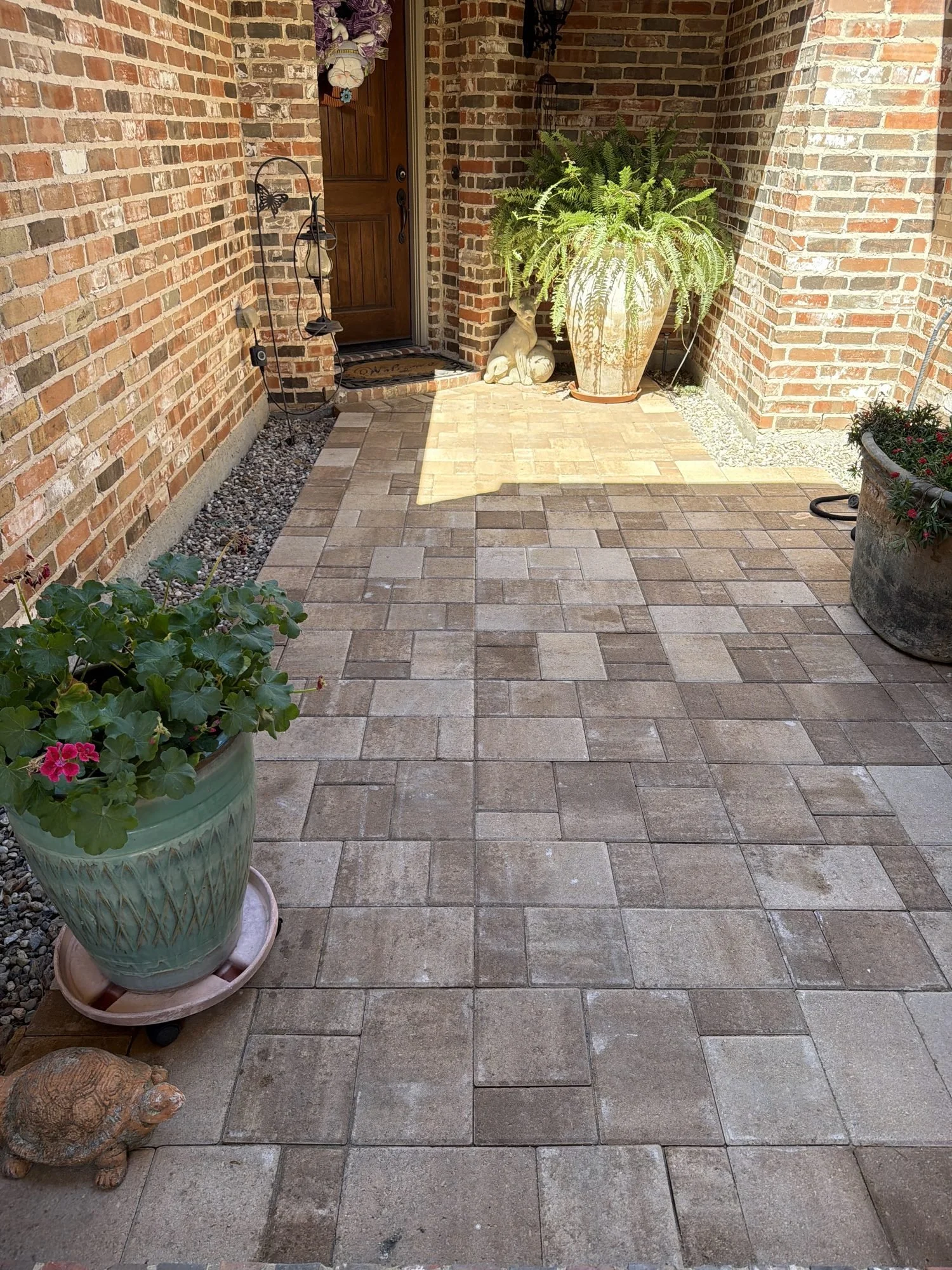
How a driveway is finished and cured affects how it performs for years. We finish with the right broom texture for traction, and we manage the cure so the surface gains full strength instead of spalling later. We also offer decorative finishes, exposed aggregate, stamping, and color for homeowners who want the driveway to be a feature. Rushing the cure to open the driveway a day early is a common way a surface ends up dusting or flaking, so we hold to the proper timeline.
Google 5.0 Rated by Homeowners Across the Lake Conroe Area
Our reputation is built on real homeowners, repeat clients, and local HOAs. Reviews below pull live from our Google Business Profile, so what you see is always current.
Rating