Why Fence Posts Heave and Lean in Montgomery County Clay
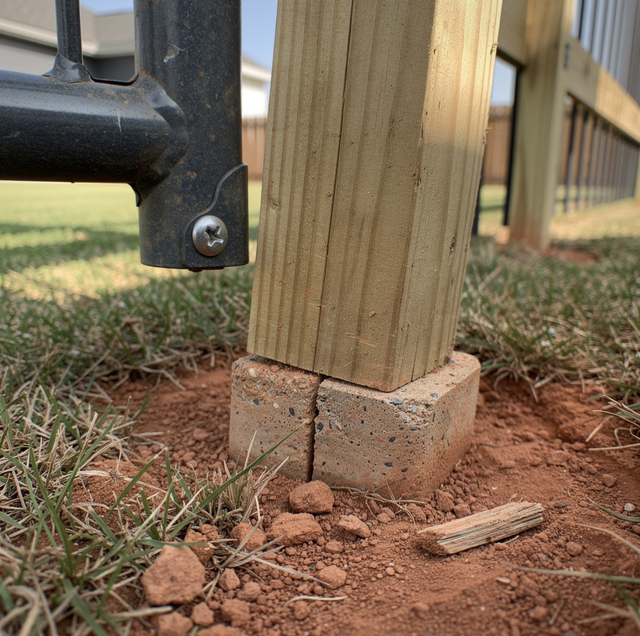
The first sign is never the fence itself. It's the gate. It swings and latches fine for a season, maybe two, then one morning the latch needs an extra shove. A few weeks later it needs a lift as well. Walk the rest of the line and one post stands a little proud of the two beside it, as if something pushed it up from underneath. By the following year that stretch leans the same direction, obvious enough that a level across three post tops shows a full run out of plumb.
None of that is storm damage. What's covered below is slower, has no weather event to point to, and starts at the post long before it ever reaches the panel.
The Gate Reports the Problem Before the Fence Does
A gate is the most sensitive instrument on a fence line, and it reports trouble in a fixed order: the latch stops meeting its catch squarely, then the gate needs lifting as well as shoving, then the leading bottom corner starts scraping an arc into the dirt.
Why the latch complains first: A latch bar and its catch are set to within a fraction of an inch of each other. Move the post carrying either one by that much and the two stop meeting. The latch has the least tolerance built into it of anything on the fence, so it registers the smallest movement.
What the drag tells you: A gate that scrapes in one spot and clears everywhere else is following its post. A gate frame racked out of square instead drops on the latch side through the whole swing, evenly, with no single low point.
| What You Notice | What's Usually Happening Below Grade |
|---|---|
| The gate needs a shove or a lift to latch | The post it's hung on has shifted at the collar |
| One post stands higher than its neighbors | The post and its footing have been pushed up together |
| A whole run leans the same direction | Several posts along that run have lost their grip on stable soil |
Most of a Post Is Above the Ground, Not in It
A typical fence post has only a fraction of its total length buried; the rest stands exposed to wind load, to the panel it carries, to a gate swinging open and shut every day it is used, and to anyone who leans on it. That force travels down through the short, buried part before the soil ever sees it.
That's a geometry problem, not just a soil problem. A small amount of movement at the buried end shows up multiplied at the top of the post: the buried section is short, the exposed section is long, and the exposed length swings through a much wider arc than the movement that caused it. This is why a post can look almost normal at ground level and still be leaning noticeably at the top rail.
Where the stress concentrates: The exposed length works against the buried end, and the highest bending stress lands within an inch or two of grade rather than at the bottom of the post. That is the point most likely to give, and the hardest to inspect, because the collar and the grass hide it.
What the Hardware and Panels Do Next
Hardware does not absorb post movement; it converts it into wear. A hinge barrel bolted to a post that has tipped a degree or two is no longer rotating on a vertical axis, so the gate leaf climbs slightly as it opens and settles back as it closes. Every cycle after that works the pin against one side of its barrel rather than turning evenly, and the resulting play is read as a worn gate rather than a moved post.
Adjustment as a diagnostic: Hardware carries a finite range of adjustment, and once it is used up, the next adjustment means new holes in the post. A gate re-adjusted more than once in a year is reporting its post, not its hardware.
Rails and pickets: A rail attached at both ends to posts no longer at the same height either bends, pulls its fasteners, or splits along the fastener line. Pickets on a tilted rail fan open at the top or close up at the bottom, so a run of even gaps turns into a run of wedges, and the eye catches that change in spacing well before it catches a degree of lean.
Wood Behaves Differently at the Soil Line
That inch or two on either side of grade is the wettest part of the post for the longest stretch of time: moisture from the soil on one side, air and sun on the other, so it cycles between wet and dry more than any other point on the post.
Pressure-treated pine resists rot and insect damage through chemical treatments driven into the wood; cedar resists them through natural oils and the density of the heartwood. Neither does much to resist the post being pushed by the surrounding ground. What treatment buys is time: a post that isn't rotting at the soil line resists that push for years longer than one that is. Once checking and surface cracking appear there, that section is weaker at exactly the point the exposed length above is straining it hardest.
Below Grade, the Hole Gets One Chance to Be Right
All of the above is downstream of one thing. Expansive clay changes volume with how much water is in it, swelling when wet and shrinking when it dries, and a post's buried end is the one place that change does real damage.
Disturbed backfill: Digging a hole breaks up ground that used to be dense and undisturbed, and what goes back in never packs to the density of the surrounding ground. That looser ring is where the surrounding soil's seasonal movement does its most damage, because loose soil has more room to move and less structure to resist moving.
Collar shape: A concrete collar is meant to spread the post's load over a wider bearing surface and give the post something solid to resist twisting and lateral push. Done right, it sheds water away from the post and bears on undisturbed soil. A collar that flares wider at grade than at its base, or slopes back toward the post instead of away from it, collects rainwater right where it soaks into the post and gives the soil more surface to push against.
Depth: A wide, neat collar at the surface can hide a hole that never went deep enough. What resists lift and lean isn't the diameter of concrete you can see; it's whether the post and its footing reach down to soil that holds still. Above that depth, the ground is still moving with the seasons. Below it, it holds its volume year-round. Widely published framing guidance calls for burying roughly a third of a post's total length, though the right depth depends on the post's height and the load it carries.
Before a post goes in, check the hole's bottom rather than its diameter. A hole that mushrooms wide at grade and tapers to a point is bearing on almost nothing, no matter how much concrete shows at the surface.
Corner posts and gate posts are usually the first to show this kind of movement, ahead of the line posts between them.
The Construction Choices That Hold Up Over Time
None of this can be engineered away. The ground keeps moving as long as the property sits on it, and no post installation, however well built, stops that from happening. What separates a fence that holds a straight line for decades from one that starts leaning within a few years is whether the construction choices worked with that movement instead of ignoring it. Anyone promising a fence post that will never move again in expansive clay is selling something that doesn't exist.
A few choices consistently separate the two outcomes:
Hole shape: Straight sides bearing on firm soil at the bottom, rather than a hole that flares out near the surface. Base material: Crushed stone or gravel under the concrete, so water reaching that depth has somewhere to go instead of pooling against the post end grain. Drainage at the collar: Shedding water away from the post instead of holding it against the wood. Depth: reaching soil that isn't cycling with the seasons, rather than just enough concrete to look solid above grade. Separation from moisture: A sleeve or a gap between the post and the collar, so the wood isn't standing in water.
Whether a gate eventually carries an automatic operator is a separate decision from how solid its post and footing are, worth its own conversation once the post work is settled. The ground doesn't care what's hung on the post, only how the hole was shaped and how deep it goes.
Frequently Asked Questions
Corner and gate posts take load from more than one direction at once: a corner post is pulled by two fence runs instead of one, and a gate post also absorbs the racking force of swinging open and shut. Many installers set those posts in a larger-diameter hole or wider footing even when the rest of the run is standard.
Usually not for long, and the reason is the panels rather than the post. Resetting one post while its panels stay fastened to their original neighbors puts that post back under load from two directions it cannot self-correct against, which is why a leaning post is normally a signal to look at the whole run's footings rather than a one-post job.
It can. A thicker post resists bending near its base better than a thinner one of the same species. Post thickness also determines whether a through-bolted gate hinge has enough meat to hold without crushing the fibers around the bolt, which is a different failure from anything the footing does.
Look at the gap along a picket edge. A gap roughly the same width from top to bottom usually means the post itself shifted. A gap noticeably wider at the top than the bottom, with the post still standing plumb, usually points to the panel frame racking, not the post underneath it.
Not entirely. A steel post is typically set in the same footing geometry as a wood one, so it heaves the same way. What changes is the failure mode: a steel post that has heaved usually stays straight and lifts the rail line with it, where a wood post of the same age tends to give at the soil line first, which is why a heaved metal fence often reads as level-but-wrong rather than visibly leaning.
Less than most people assume, but moisture in the ground at the moment of backfilling matters. Backfill placed during a wet stretch can look solid on installation day and still leave hidden voids once it dries back weeks later, so a footing's compaction has more to do with soil moisture at that moment than the season on the calendar.
Every fence post is running the same experiment: soil pushing on wood or concrete, with the exposed length turning any small shift at the bottom into a visible wobble at the top. It isn't a fight that ends, only one that either gets designed for or doesn't.
Walk your fence line with a builder — get an honest read on which posts are still doing their job and which ones need to come out at the footing instead of just getting patched at the top. Palacios Construction Group serves Willis, Conroe, and The Woodlands. Call (936) 828-8664.
