Quartz vs Granite vs Sintered Stone for a Hard-Use Kitchen
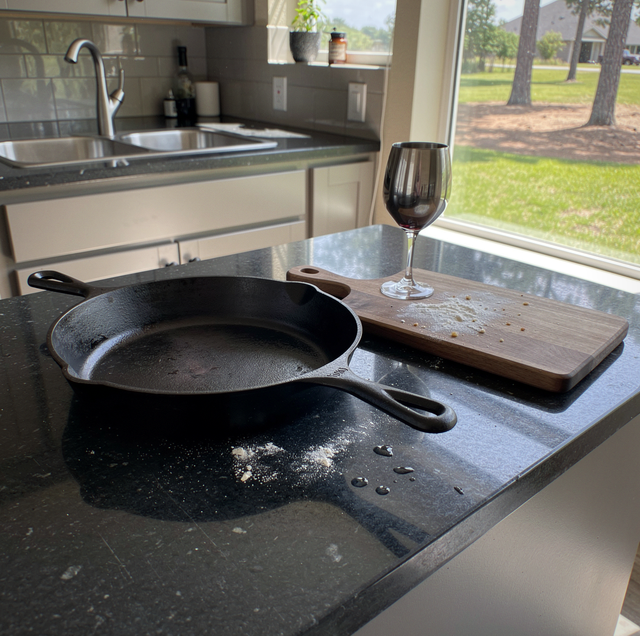
A hot pan gets set down without a second thought. A glass of wine sits on the same corner overnight. A knife goes straight to the surface because the cutting board is one drawer too far away. A cast-iron skillet lands square on an edge, harder than intended. Those are the events a countertop is chosen against, and they happen far more often than the single chip that comes to mind first.
Quartz, granite, and sintered stone answer those four differently. Each trade resists one insult with a weakness against another, and which trade matters most depends on how your kitchen gets cooked rather than on which material sounds newest.
Heat, and What Daylight Does to the Binder
Direct heat: granite and sintered stone (Dekton, Neolith, Lapitec, and Pelican Solstone are common sintered lines) both take a hot pan without a trivet because neither relies on an organic binder that heat can damage. Several published sintered-stone care guides still ask for a trivet under a cast-iron pan straight off a burner or a broiler, where concentrated point heat can mark some finishes.
Quartz is different. A polymer resin holds it together, and that resin is not rated for direct, sustained heat. Set a hot pan on quartz without a trivet, and the resin around the contact point can scorch or discolor, sometimes for good. That same resin binder is what daylight works on over years, which is why an outdoor top is a different question entirely.
Neither is immune to every heat event. An extreme, concentrated burst along a natural vein can occasionally crack a cold slab. That is uncommon, and it says more about a weak point in that slab than about the material, but a trivet is the habit that avoids testing it.
A Spill Left Overnight, and Whether Anyone Reseals
Granite is a natural stone, and its surface may have an open-pore structure depending on the slab's mineral makeup.
Porosity: An unsealed or under-sealed stretch of granite is the one surface of the three with a real chance of taking a stain from wine, coffee, or an oily sauce left overnight, because that is what an open pore does with a liquid given enough time. Quartz and sintered stone do not carry that risk, and neither asks for a sealing routine.
Which puts the real question on the household rather than the slab. A fabricator can read a slab's sealing needs from its mineral makeup; nobody can say in advance whether anyone will remember to renew it, year after year.
Maintenance habits: A household that skips upkeep across the board- the kind that never gets around to resealing a deck or a grout line either- is better served by quartz or sintered stone, since neither depends on a sealing routine to resist a spill.
A quick check for whether granite still needs sealing: set a few drops of water on the surface. If it beads and sits, the seal is holding. If it darkens or soaks in within a few minutes, it's time to reseal.
Knife Marks and a Chipped Edge
All three are hard enough that an ordinary steel knife will not cut into them the way it cuts wood or plastic. What changes is how each wears under the habit of skipping the board. Skipping one wears fine lines into quartz's resin faster than it wears sintered stone, which resists a blade better than a resin-bound surface does. Granite sits between the two, shrugging off most knife contact but picking up fine scratches over years across a softer mineral band.
Overhead kitchen light hides most of this. An undercabinet light angled low, raking almost parallel to the surface, tells a different story: the texture the surface has picked up becomes a field of tiny shadows at that angle. On quartz, that light usually finds a faint web of hairline scratches near the stove and sink. On granite, the same angle shows little on the polished mineral but picks out a hazy patch where sealer has worn thin, since light reflects differently off an open pore than off a sealed one. On sintered stone, that light usually shows nothing outside an edge, since the surface holds one uniform finish across its span.
A heavy pot or cast-iron pan dropped square on an edge, especially a thin or mitered one, can chip any of the three. What happens after is where they separate. Edge repair: A granite chip can be ground down and re-polished in place by a stone restoration specialist, since the material is one uniform mineral through and through. A quartz chip can usually be filled with color-matched resin, workable because quartz is resin-bound to begin with.
Sintered stone has neither option. The same fired, resin-free body that gives it scratch and heat resistance also keeps it from being honed, reground, or re-polished the way a natural stone can. A chip at a sintered edge keeps that chip for as long as the top is in the kitchen. That is a consequence of the hardness that makes the material attractive, worth weighing before a slab gets ordered rather than after a pot gets dropped.
A countertop chip leaves an edge sharp enough to cut a hand reaching over it, and the loose fragment is worth keeping. A fabricator matching a repair works from the broken-off piece, not from a photograph of the gap.
Seams and the Sink Cutout
A countertop rarely cracks out in the open field of a slab. It cracks where material was taken away: at the corners of a sink or cooktop opening, along the narrow rail in front of a sink, and where two slabs meet.
The cutout corner: a square inside corner concentrates stress at one point, which is why a fabricator radiuses the corners of a cutout instead of cutting them sharp, and why a steel rod or reinforcing strip often goes into the narrow rail in front of a sink before the top ships. Ask what the shop does on your cutout; that answer varies shop to shop more than material to material.
Undermount against top-mount: An undermount sink hangs from the underside of the slab, so the cut edge is exposed and polished, and the slab carries the sink plus whatever sits in it. A top-mount drops into the opening, and its rim covers the cut edge, taking the finished-edge question off the table. Granite and quartz both polish to a finished undermount edge routinely. Sintered stone is where the difference shows: its fired body is unforgiving to rework, so an undermount edge and a mitered rail want to be cut and finished at the shop, not adjusted on site.
Seams are bonded with a color-matched adhesive and pulled tight with seam setters. On granite, pattern decides whether a seam reads as a line or disappears, so where it lands is a slab-layout decision made before anything is cut. On quartz, consistent color makes a seam easier to hide. On sintered stone, a mitered edge or a waterfall leg is worth settling before the slab is ordered, because the material does not forgive a change of mind at the saw.
What Each of the Four Changes on the Order
Each of the four insults changes something specific on the fabrication order, and those details are easier to get right before a slab is templated than after it is set.
| If This Happens Weekly | Materials That Take It | What to Put on the Order |
|---|---|---|
| A hot pan lands without a trivet | Granite, sintered stone | Ask which finish is on the sintered slab: matte and textured finishes reflect heat differently than a polished finish does. |
| A spill sits overnight, and nobody reseals anything | Quartz, sintered stone | If granite is still in the running, ask which sealer the shop applies at fabrication and what reapplication that product expects. |
| A knife goes straight to the counter | Sintered stone, granite | Ask for a honed or textured finish rather than a high polish, which reads every fine scratch sooner. |
| A pot gets dropped on an edge | Granite, quartz | Ask for an eased or bullnose profile instead of a thin square arris, and whether the shop repairs its own edge chips later. |
Order the Surface Around the Insult That Worries You Most
Deciding variable: Which insult this counter takes weekly, not which one takes it worst. No single ranking holds for every kitchen, because it depends on what happens on that counter week to week rather than on a spec sheet.
Quartz gives up heat and light tolerance for a surface that never needs sealing and resists staining outright. Granite gives up some stain resistance and requires occasional sealing, in exchange for an edge that can be repaired if it chips. Sintered stone sacrifices edge repairability to achieve resistance to heat, staining, and scratching at once.
Frequently Asked Questions
A fabricator matches a chip by blending resin filler from an offcut of the same slab rather than from a generic kit, since dye lots vary slab to slab. The original fabricator is usually best positioned to do it later, because that offcut is the piece they still have on the rack.
Yes. Every material has an unsupported overhang limit its fabricator will state for that slab thickness, and past it a hidden corbel or steel bracket goes into the cabinet below. Ask for the limit in writing on the slab you are ordering, since the counter's own weight rather than an impact is what cracks it at the cabinet line.
Yes, or at minimum its installation sheet. The cutout is dimensioned from the appliance manufacturer's own drawing, including the clearance it states between the opening and what sits beside it, so a template made from a catalog number is how a slab comes back with an opening the unit doesn't drop into. The same is true of an undermount sink, traced from the bowl itself.
A penetrating sealer soaks into the stone's pore structure and cures below the surface rather than sitting on top as a film, which is why a properly sealed top doesn't look or feel any different afterward.
Coverage generally attaches to the installation as well as the slab, so it runs through the fabricator who templated and set the top: a repair made later by a third party, or a top lifted onto a different base, can end coverage that was otherwise still running. Direct heat damage is separately excluded on most published quartz warranties, Cambria's among them.
It calls for a diamond polishing pad system rather than the compounds used on marble or granite, which are formulated for a natural mineral surface and don't cut a ceramic-like body the same way. Even then, the result is a reworked edge, not a restored one, which is why a sintered top is detailed at the shop and set once.
The material that wins on paper is not always the one that wins in a particular kitchen. A quartz top in a house where nobody remembers to reseal anything, with a hot pan landing on a trivet out of habit, is the right call there. A granite top in a house that doesn't mind an afternoon spent resealing, in exchange for an edge that can be made good again after years of hard use, is just as right. The first honest step is to name the insult this kitchen commits most often before a slab is ordered.
Pick the top that best reflects how the kitchen is actually used — walk through which situation above matches your household before you choose among quartz, granite, and sintered stone. Palacios Construction Group serves Willis, Conroe, and The Woodlands. Call (936) 828-8664.
