Why Quartz Is the Wrong Top for a Texas Outdoor Kitchen
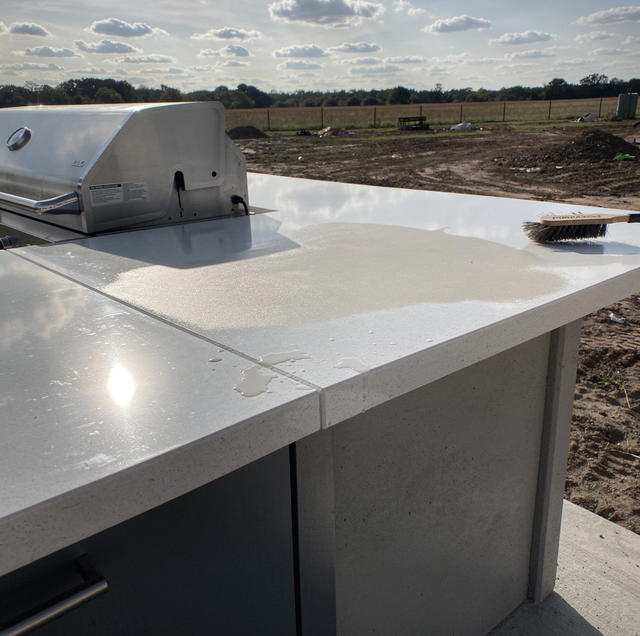
Set an engineered quartz slab into an outdoor kitchen island in early spring and leave it there through a full season of sun, and by the time cooler weather returns, it has been through a history nobody planned for. Mid-morning heat climbs across the surface and holds well past sunset. Ultraviolet light lands on the same stretch of resin and pigment, day after day, for months without a break.
A grill lid a few feet away throws its own heat across the surface every time dinner gets cooked, stacked on top of whatever the sun already did that afternoon. None of that is a single event. It is a slow accumulation that affects the slab itself, not something sitting on top of it.
Engineered Quartz Is Crushed Stone Bound with Resin
Composition: Engineered quartz is not a single quarried stone. It is crushed natural quartz, ground fine, mixed with pigment, and bound together with a polymer resin, then compressed and cured under heat and pressure into a slab. By weight, the great majority of the slab is crushed stone, with resin and pigment making up the remainder. The stone particles themselves do not care about sun or heat. Resin does.
That resin is exactly what makes engineered quartz useful in a kitchen. It seals the surface, so there's no sealing schedule as there is with natural stone, and it maintains consistent color and pattern from one edge of a slab to the other. Indoors, protected from direct sun and wide heat swings, the resin does its job for decades without complaint. Outdoors, on a patio that takes a full afternoon of sun, it's asked to do something it wasn't built for.
Ultraviolet Light Breaks Down the Resin and the Pigment
Ultraviolet light breaks polymer chains apart at the molecular level, a process material scientists call photodegradation. In a painted wall, that process works on a thin surface coating. In an engineered quartz slab, the resin is not a coating. It is mixed throughout the material, holding the stone particles together across the full thickness of the slab.
Sustained UV on an uncovered surface breaks that binder down starting at the exposed face, and the pigment suspended in the same resin fades and shifts color along with it. The change arrives as a general loss of depth across the whole exposed face rather than as a mark in one place, because every square inch of that face is taking the same light for the same hours.
Heat and Thermal Movement in a Slab That Is Part Polymer
Two materials expanding at different rates: Stone and polymer resin do not expand and contract by the same amount as temperatures swing. A slab sitting in full sun for hours, then cooling overnight, puts the bond between the crushed stone and the resin holding it through a small mismatch in movement, over and over across a season. Natural stone alone does not have this problem, since it is one material end to end.
Engineered quartz is always two materials bonded together, and that bond is what a long, hot outdoor season tests hardest. Corners, cutouts around an appliance, and anywhere the slab is fixed rigidly to a base carry more of that repeated stress than the open field of the countertop does.
A Grill, a Burner or a Hot Pan at Close Range
Ambient summer heat slowly and evenly warms a countertop across its entire surface. A grill lid, an open burner, or a hot pan set down directly does something different. It delivers heat to one small area, fast, at a level the resin was never asked to absorb evenly across the rest of the slab.
On a quartz surface that has taken repeated heat right at the edge of a grill island, the sheen goes first in that one spot. A strip along the grill side turns slightly matte while the rest of the same slab, a foot or two away, still holds its full polish. It isn't a burn mark, and it isn't a crack. It is the resin's surface finish giving up its gloss exactly where the heat load has been heaviest, in a shape that outlines the equipment sitting next to it, not the whole countertop.
The strip of countertop nearest a grill or burner runs hotter than the rest of the slab and stays hot after the flame is off. Keep bare skin, towels, and plastic tools clear until it has cooled.
Moisture and Freeze Behavior at the Edges and Seams
Where water finds a way in: The field of an engineered quartz slab is nearly non-porous, so it resists staining and requires no periodic sealing, unlike natural stone. Seams and edges are a different story. A seam is filled with an adhesive, and a built-up edge profile depends on that same kind of bond staying intact. Water sitting against an outdoor countertop, from rain, condensation, or a hose rinse, can work into a seam or an edge joint that has opened even slightly.
A stressor that cuts both ways: In any climate that sees even an occasional hard freeze, water trapped in that gap expands as it freezes and can widen the separation further. In a climate that rarely freezes, the same gap still lets moisture cycle in and out season after season, its own slow problem for an adhesive bond that was never meant to sit wet outdoors.
What Belongs on an Outdoor Kitchen Instead
None of this rests only on what a fabricator has learned by watching failures over the years. Quartz producers publish their own installation and care guidance, and that guidance is written around interior use. Full outdoor exposure typically falls outside what the material's warranty covers. That is the manufacturer's own published position on what the slab was built for, and it is the single strongest argument for putting something else on an island that sits under open sky.
The two materials this routes to: For an outdoor countertop, the recommendation lands on one of two families: granite, a natural quarried stone that has handled sun and heat outdoors for as long as people have built outdoor kitchens, or sintered stone, produced under names including Dekton, Neolith and Lapitec, a manufactured surface fired at extreme temperature and pressure with essentially no resin content and correspondingly little for UV to break down.
Weighing granite, sintered stone, and quartz for an indoor kitchen is its own decision with its own trade-offs; the only question outdoors is which of the two belongs on a patio that gets full sun.
What moving off quartz gives up: Indoors, quartz is the more forgiving choice for most kitchens, and giving that up outdoors is a real tradeoff. Quartz's color runs consistently from one slab to the next in a way a natural material cannot promise, and a second island ordered years later can reasonably be expected to match.
What granite gives up: Move to granite and some of that goes away. Color and veining vary slab to slab, and it comes with the upkeep expectations of a natural material in a way quartz never did.
What sintered stone gives up: Move to sintered stone, and the tradeoff is different. It is the most UV-stable of the three because there is almost no resin in it to break down, but it's unforgiving to fabricate, and adjusting an edge or adding a cutout after installation is harder than with either granite or quartz. The reasons people want quartz- its consistency and its freedom from sealing- are real ones. An outdoor grill island is not where they win.
Frequently Asked Questions
A roof over the cooking area blocks direct ultraviolet exposure, which does slow the fading and chalking side of the problem. It does nothing to reduce the heat from sitting a few inches from an open flame or a hot pan, so the heat-related risk to a quartz top remains about the same whether the patio is covered or open to the sky.
Distance from the grill only addresses the heat side of the problem. The same top still sits under open sky, taking the same daily ultraviolet exposure and the same humidity cycling as the cooking surface a few feet away, which is why every top in an outdoor kitchen gets routed to the same recommended materials, not just the piece nearest the flame.
A full-height slab backsplash mounted directly behind a grill hood typically sits closer to the equipment's radiant heat than the countertop surface in front of it does. If either piece shows heat-related change first, it is usually the backsplash, not the counter.
A chip exposes the crushed-stone aggregate beneath the sealed resin surface, and that aggregate does not resist water as the intact finish does. A damaged edge left outdoors tends to take on moisture and show wear faster than an undamaged edge on the same slab.
The finish does not change the underlying chemistry; both are the same resin reacting to the same UV. What changes is how visible the damage is. A honed finish has no gloss to lose, so the first visible change on a matte top is a shift in color rather than the dulled strip a polished top shows along its heat-loaded edge.
No, and the reason is specific to outdoors. A sealer on an outdoor granite top is holding off grill grease and smoke rather than kitchen spills, which is why fabricators generally set the reapplication interval for an outdoor slab shorter than it would be for the same stone indoors. Granite's pores are open enough to take that oil in if nothing is sitting in them.
Every material in an outdoor kitchen is subject to the same sun and heat, whether or not it shows wear the same way. The top is the one component nobody can swap on its own: it is templated to the base below it, the grill and the doors are cut into it, and the cabinets under it are set to its height. Changing a burner is an afternoon. Changing the slab means taking the island apart around it, which is why the top is the piece to decide on first.
Choose an outdoor surface that survives the season — get a granite or sintered-stone top templated, fabricated, and installed for your outdoor kitchen. Palacios Construction Group serves Willis, Conroe, and The Woodlands. Call (936) 828-8664.
