Waterproof LVP vs Engineered Hardwood in Gulf Humidity
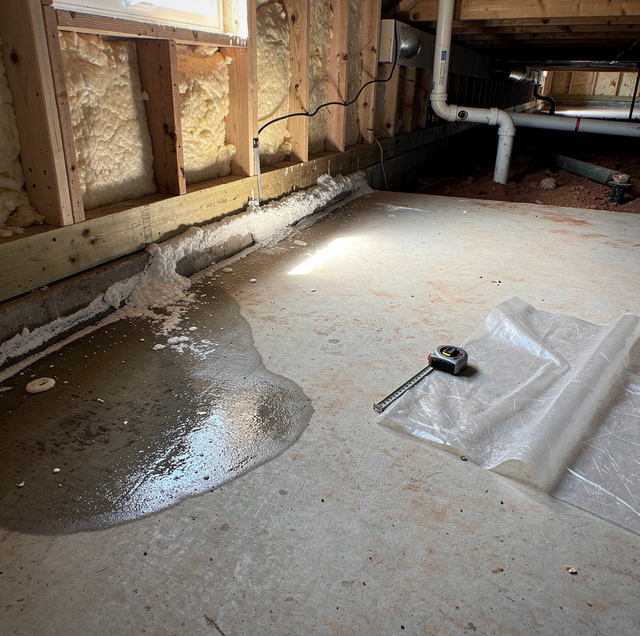
The word "waterproof" on a luxury vinyl plank box describes the plank. It does not describe the floor. A plank can shed a spilled glass of water all day, and the floor around it can still fail, because the failure rarely starts at the surface. It starts underneath, at the subfloor, the seams, and the edges where the installed system meets a wall, a transition, or a door threshold.
Engineered hardwood carries the opposite reputation problem: real wood, so it must be the one that struggles in a house that runs humid for months at a time. Both reputations are half right and both miss where the actual risk sits. The material matters less than what is happening below it and around it.
Waterproof Means the Plank, Not the Floor
Waterproof LVP is accurately named. The plank itself, whether it is a rigid-core SPC product or a flexible WPC product, is a manufactured composite that does not absorb water and will not swell, cup, or rot from moisture contact at the surface. That part of the claim holds up in a shower splash, a pet accident, or a slow leak sitting on the surface overnight.
What the claim does not cover is everything below the wear layer. A click-lock LVP floor consists of individual planks locked edge-to-edge, floating over the subfloor. The seams between planks are mechanical joints, not sealed barriers. A glue-down LVP installation bonds the plank directly to the subfloor, which removes the floating-seam issue but introduces a different one: the adhesive and the subfloor beneath it now have to tolerate any moisture moving through the slab or framing, because nothing stops that migration at the plank level.
Where real LVP failures start: moisture rising through a concrete slab that was never tested or sealed before installation; water finding its way under the floor at a poorly sealed transition or exterior door; or a subfloor that stayed damp after the pour and was just covered up. The plank does not care. What sits directly under it does.
Engineered Hardwood's Stability Is Not the Same as Vinyl's
Engineered hardwood is built from cross-layered plies under a hardwood veneer, which is precisely why it handles humidity swings better than solid hardwood does. The layered construction resists cupping and gapping that solid wood exhibits as moisture content changes with the seasons. That is a genuine, real advantage over solid hardwood, and it is the reason engineered wood exists as a category.
It is not, however, equivalent to a fully waterproof product. Engineered hardwood is still wood at the surface.
What the veneer still does: It takes on moisture if it sits wet, it expands and contracts with the room's humidity, and it needs an acclimation period in the space before installation, so the planks settle to the actual conditions of the house rather than the humidity of a delivery truck or a warehouse.
What skipping that step costs: In a house that runs humid for a long stretch of the year, the floor can show gapping or slight cupping within the first season, even though nothing was installed wrong. The fix is not a better plank. It is about respecting the acclimation window and keeping indoor humidity steady with normal HVAC operation, just as any wood floor in any climate requires.
LVP Does Not Have to Look the Way Old Vinyl Looked
A lot of resistance to LVP traces back to sheet vinyl and early plank vinyl: visible repeating patterns, a plasticky sheen, a hollow underfoot feel. Current wood-look and stone-look LVP uses high-resolution printing and embossed texture registered to the print, so the grain you see lines up with the texture you feel under a bare foot.
Even so, a thin wear layer over a low-density core still reads as exactly that, regardless of category. Press a knuckle against the surface near a seam: a hollow-feeling core gives back a light, drummy rap, while a dense SPC core returns something closer to a dead, solid thud, even with the same photo print running across both. The tell is not the material family; it is the wear layer and the core density underneath it.
Refinishing Is a Real Advantage, With a Catch
Engineered hardwood can be sanded and refinished, but LVP cannot; once an LVP plank wears through or is damaged, the whole plank or the whole floor must be replaced.
The catch is thinner than it sounds. Refinishing depends entirely on the thickness of the actual hardwood veneer layer sitting on top of the plywood core, not on the plank as a whole.
What the number actually measures: That veneer is specified in millimeters, and it is the number worth reading before assuming a floor can be refinished later. A generous veneer can typically take a light sanding pass or two over the life of the floor. A thin veneer may only tolerate one light pass, or none at all, before the sander cuts through to the plywood underneath.
What the claim is worth: "You can always refinish it" is a fair statement about the category. It is not a fair statement about any specific product until someone has actually read the veneer spec, because a floor that cannot take a sander is functionally no more repairable than LVP, and replacing it means pulling the whole field rather than swapping the damaged planks.
Before signing off on an engineered floor, ask for the veneer thickness in millimeters in writing rather than the plank's overall thickness. The two numbers get quoted interchangeably, and only one of them decides whether the floor can ever be sanded.
The Subfloor Decides More Than the Plank Does
This is the part both materials share, and the part a showroom sample cannot show. A subfloor with hidden moisture, whether from a slab that was never checked for vapor emission or wood framing that got wet during construction and was closed in before it fully dried, creates a sealed, dark, warm cavity once any floor goes down on top of it. That is a genuine setup for mold and mildew growth under the finished floor, invisible until a smell shows up or the flooring itself starts lifting or discoloring at the seams.
A subfloor with trapped moisture becomes a sealed, dark cavity once flooring covers it. Mold and mildew can develop underneath without a visible sign until a smell appears or the floor itself starts failing at the seams.
Neither an LVP wear layer nor an engineered hardwood veneer changes this risk in either direction. What changes it is whether the subfloor was actually tested and prepped, moisture barriers installed where the situation calls for one, and old, damaged, or wet subfloor material removed and replaced rather than covered. A wood-look floor over a compromised subfloor is a wood-look problem waiting to surface later, dressed up as a flooring choice. Flatness matters as much as dryness: a floating floor spans a dip without complaint, and a glued one telegraphs it through as a soft spot underfoot.
So Which One Actually Wins
For a house that runs humid for months at a time, waterproof LVP is the more forgiving material wherever moisture exposure is a real, ongoing possibility. It tolerates surface moisture and humidity swings without the acclimation sensitivity wood carries, and current product lines close most of the look gap that used to be the honest tradeoff.
Engineered hardwood wins on the thing LVP cannot do at all: it is real wood, it reads as real wood underfoot and in direct light, and it can extend its life with a refinish, provided the veneer spec actually supports one. Which of those two arguments applies is set by the room, one room at a time.
| The room being floored | What fits it | What settles the call |
|---|---|---|
| A mudroom that takes wet boots daily | Waterproof LVP, glued down | Water arrives at floor level as routine, not as an accident |
| A kitchen with an ice-maker line | Waterproof LVP | The leak that matters is slow, hidden behind an appliance, and found late |
| A bedroom over a slab | Either, once the slab is tested | Vapor emission out of the slab settles it before the plank does |
| A study or formal living room | Engineered hardwood | Indoor humidity is already held steady, so the surface can be the priority |
| A hallway between a wet room and a dry one | Either, with the transition detailed | Water crosses at the threshold, not out in the field of the floor |
Neither material solves a moisture problem that starts below it. The room decides this, not the sample board: a mudroom and a study are not asking the same question of a floor.
The limit worth saying out loud: A house that runs humid outdoors but holds steady humidity indoors, with HVAC that runs continuously rather than in long off stretches, is not a house that needs to be talked out of wood floors. Saying that plainly ends the larger material conversation before it starts.
The honest version of this decision has less to do with which plank looks better in a showroom and more to do with what the subfloor is doing and whether a refinish claim is backed by a real veneer number.
Frequently Asked Questions
Most rigid-core SPC products come with an attached foam or cork underlayment built into the plank, which handles minor subfloor irregularities and provides sound damping; a separate vapor barrier is a different product entirely and is a subfloor-prep decision made before the plank goes down, not a feature of the plank itself.
Below-grade slabs are the exception most often missed: many engineered-wood warranties permit installation on grade and above grade while excluding below grade outright, and that limit sits in the warranty text rather than on the sample board. Above that line, engineered hardwood goes down over slab by glue-down or floating method, unlike solid hardwood, which is far more limited over concrete.
A refinish removes a measured depth of material, not a fixed number of passes, so what is left of the hardwood veneer above the glue line sets the count, and the plank's total thickness never does. A floor already sanded once by a previous owner carries no marking to say so, and the only reliable read is a small cut at a threshold or under a register, where the layer stack shows in section.
Glue-down needs a flatter subfloor than click-lock does, because the adhesive cannot bridge a dip: a hollow that a floating floor spans without complaint telegraphs through a glued plank as a soft spot underfoot. Floating installations also need a perimeter expansion gap left at every wall and vertical obstruction, covered afterward by base or quarter round, and a glued floor does not.
A calcium chloride test or an in-slab relative humidity probe measures the moisture actually leaving a slab, and both should be done before flooring goes down rather than after. On a floor already installed, the simplest read is a taped-down sheet of clear plastic left on the surface overnight: condensation on its underside means vapor is still moving up through the assembly.
No; grain direction and plank orientation are visual and layout decisions, not moisture-performance factors. Humidity performance is governed by the core or veneer construction and the subfloor condition, not by how the planks are arranged in the room.
Choosing well comes down to matching each room's actual moisture exposure to the material, then making sure what is underneath the floor is handled with the same care as what goes on top of it.
Compare flooring against how your house actually lives — get a straight answer on which material fits which room before anything gets ordered. Palacios Construction Group serves Willis, Conroe, and The Woodlands. Call (936) 828-8664.
