Cabinet Refacing vs. New Custom Cabinets: Four Checks
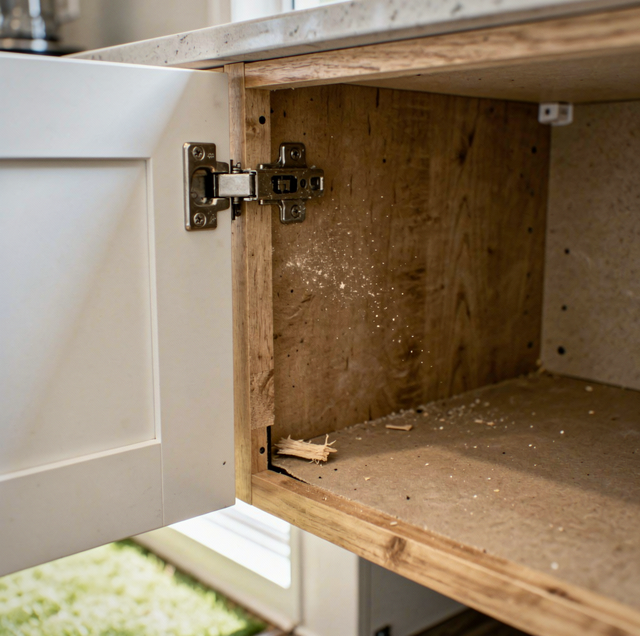
Can I keep my boxes? That is the real question behind almost every cabinet project, and there's a way to answer it without guessing. Work through four things in order: what the boxes are actually built from and whether the joints are still tight, whether the current layout is doing its job or you've just been living around it, whether anything behind the doors is about to move or change, and how far a new door style and finish can actually take what's already installed. Get through that list honestly, and the answer to reface or replace falls out on its own.
The Boxes Decide Whether Refacing Even Applies
A box holds a hinge, holds a screw and keeps its shape, or it doesn't, and that has nothing to do with what finish eventually goes on the outside of it.
Substrate: Some materials take a screw cleanly and keep taking it after years of a door swinging on it. Others soften over time, especially once moisture works its way in, and no amount of new veneer glued over the surface changes what's underneath it.
Joinery: A box held together with dovetailed or doweled joints keeps its square as the house moves around it. One, held together mostly with staples and glue, starts to separate at the corners, and once a corner opens up, refacing it glues a new face onto a frame that's already coming apart.
Water damage and sag: These are the two conditions worth checking hardest, because both hide in plain sight. Look for swelling low on a cabinet run where water tends to collect, or a wall cabinet or a stretch of base boxes that's started to lean or drop out of level. Either one means something underneath the finish has already failed, and exactly where that line falls on a specific box is worth walking through in person rather than guessing from a list.
Is the Layout Actually the Problem?
Refacing changes how the kitchen looks. It does not change where anything is.
What a new door can't move: If the actual complaint is that the island is too small or that the path from the stove to the sink cuts through a doorway, no new door style solves it because the footprint stays exactly where it is. Boxes sized in catalog increments rather than to the room are a layout problem, not a finish problem, and they call for new boxes.
Refacing is the right tool when you like where everything is and just don't like how it looks or feels to use, not when you've been quietly working around a layout that was never right.
What's Moving or Changing Behind the Doors
Before a finish gets picked, decide whether anything mechanical is changing.
Rough-in forces the question: Moving a sink to a different run, adding a dedicated circuit for a new range or a beverage cooler, or relocating a vent hood all mean opening the wall or the box behind it. A box that has to be cut into for new rough plumbing or wiring isn't a candidate for a refaced front wrapped around ragged cut lines.
Who does that work: Rough-in is coordinated through a licensed master plumber or electrician as part of the remodel, never as a standalone repair. Confirm it before the finish gets chosen, because a box that has to come out for access makes the refacing question moot for that section of the run even if the rest of the kitchen's boxes are sound.
What a Refaced Door Can and Can't Become
On a box that's sound, refacing goes further than a coat of paint. New doors and drawer fronts can move you to shaker, raised-panel, or a flat slab profile, in a painted furniture-grade finish, a sprayed lacquer, or a wood veneer that keeps real grain running instead of covering it over. New hardware, new soft-close hinges and slides, and a matching veneer or finish on any exposed box end or panel mean very little of the old kitchen still reads as old once it's finished.
Two things decide what's actually deliverable on a given box, and both are worth checking before you settle on a specific door style.
Face-frame or frameless: A construction detail fixed when the boxes were built, which changes how a new door sits against the box and how much reveal shows around it.
Hinge and hardware compatibility: Whether what's already mounted works with what's going on the front of it. Worn hinges are a hardware problem a reface corrects as a matter of course, not a reason to second-guess the box underneath them.
Open each existing door and let it swing shut on its own. A door that drifts, then clatters into the frame instead of settling home quietly, is a worn hinge rather than a failing box.
What a Reface Locks in for Good
Whatever the boxes' footprint, height, depth and opening sizes are today, they stay that way.
Fixed when the boxes were built: A base cabinet's depth, an upper cabinet's height off the counter, the width of the sink base, the size of an opening cut for a range or a dishwasher, and which side each door hinges from were all settled at build time, and a reface doesn't reopen any of it.
That's fine when those dimensions already work for how the kitchen is used, and it's the whole reason refacing exists as an option: it lets you change everything you see without touching anything that would require new framing or a new floor plan. Countertop material is its own decision with its own tradeoffs, made independently of what happens to the boxes underneath it.
What a reface can't add: Storage that isn't there, or a rerouted walkway. Both need new boxes in new positions, not new faces on old ones.
Match Your Situation to the Right Call
Put the checks above together and most kitchens land in one of five places.
| Box Condition | Layout Already Works | Anything Moving Behind the Doors | Right Call |
|---|---|---|---|
| Solid, square, dry | Yes | No | Reface the existing boxes |
| Solid, square, dry | Yes | Yes (a sink, vent hood, or circuit is relocating) | New boxes for that run; reface the rest |
| Solid, square, dry | No (storage is short or the walkway is wrong) | Either | New custom boxes, built to the actual space |
| Substrate has softened, separated, or taken on water | Either | Either | New boxes, regardless of layout |
| Sagging, racked, or joints separating | Either | Either | New boxes, regardless of layout |
When Each One Is the Right Project
When the boxes are sound, and the layout already earns its keep, refacing is the right recommendation, full stop. The reverse holds just as often: a kitchen with a failing box or a layout that's never worked gets a new coat of paint's worth of improvement from refacing, yet still has the same problem waiting on the other side.
Refacing also has a ceiling nobody mentions at the door-sample stage. Once new doors are hung on old boxes, the interior is the one part of the kitchen that will still look and work exactly as it did, and a homeowner who opens those doors every day is the one most likely to notice.
The four checks above are what separate those two outcomes, and they're worth running through before you commit to either project, because refacing and a full custom build solve two different problems, not two versions of the same one.
Once you know which problem you actually have, the next step is getting someone to look at the boxes themselves rather than guessing from a photo or a showroom door sample.
Frequently Asked Questions
Yes. A drawer box sits inside the frame opening rather than being part of the veneered surface, so it's common to install new soft-close drawer boxes on full-extension slides during a refacing project even though the surrounding face frame and the doors around it are only being refaced, not rebuilt.
The shelving itself is usually left as-is, but a pull-out tray, a trash and recycling pull-out, or a divided pot-drawer insert can be added behind refaced doors as long as it's sized to fit the existing opening, since the box behind the new door isn't being rebuilt to a new interior layout.
Yes. The same veneer or finish ordered for the new doors can also be applied to a paneled appliance front, which keeps a builder-grade panel from ending up mismatched once the rest of the kitchen changes color or door style around it.
Crown and trim pieces typically get remade to match the new door profile rather than reused, because the original trim was usually cut to fit the old door style and won't sit flush against a new stile width or a squared edge.
Coordinated under-cabinet lighting is usually run and finished at the same time as refacing, since the fixtures mount to the underside of the wall cabinet box itself rather than to the door, so a lighting upgrade layers cleanly onto a reface without needing new boxes.
Swollen particleboard, delaminated melamine, or a water-damaged MDF core at the toe kick or under a sink base are conditions that rule out refacing entirely, because the new veneer needs a stable, hard substrate to bond to, and none of those three provide one.
Have your existing cabinet boxes assessed — and get a straight answer on refacing versus a new custom build before you commit to either one. Palacios Construction Group serves Willis, Conroe, and The Woodlands. Call (936) 828-8664.
