Board-on-Board vs Side-by-Side Privacy Fence Construction
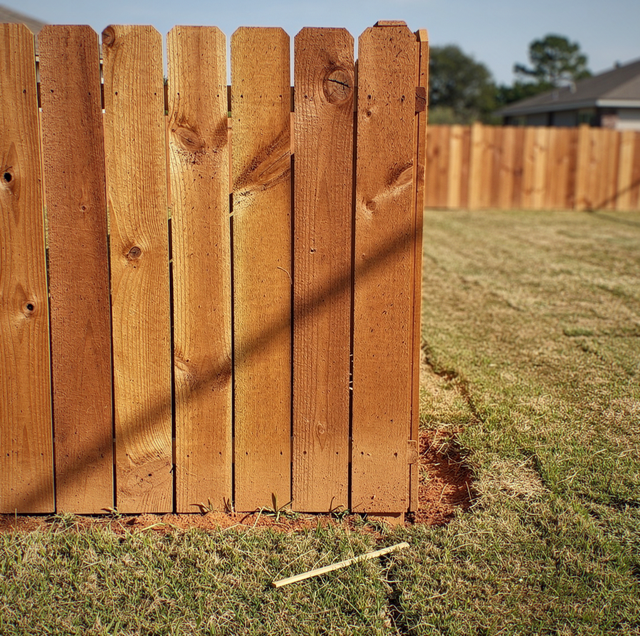
A privacy fence has two faces, and two different people look at each one. You see the front of your own fence from your own yard. Whoever lives on the other side of that line sees the back of it every day, whether or not it was built with their view in mind. That split is the first real difference between the two builds.
Two Faces, One Fence Line
Side-by-side: Boards mount edge to edge on a single row of rails, with a narrow gap between boards and the same flat plane showing on both faces.
Board-on-board: Two rows of boards are fastened to the same rails from opposite sides, each row overlapping the gaps in the other, so no straight sightline runs through the fence from either yard.
From the far end of a long run, in flat daylight, the two faces report differently before a single board resolves. A side-by-side line closes into one continuous plane, a wall of a single color, the gaps between boards dropping out of sight long before the run does. A board-on-board line remains legible as separate boards at that distance because the front row stands proud of the back row and retains its outline after the gaps no longer register. Neither look is wrong; they're simply not the same fence, and that's the difference a homeowner lives with every day.
Both start from the same frame: posts, rails running between them, cedar or pressure-treated pine fastened on. What differs is how the boards sit on that frame, and that difference drives the rest of this comparison.
What Drying Boards Do to Each Build
New fence boards arrive holding more moisture than they will carry after a season or two outside. As they dry, they narrow, every board a little, at its own pace, depending on grain and exposure.
Shrinkage: On a side-by-side run, boards installed with a tight, consistent gap can open a visible seam as they dry, because there's nothing else in that plane to cover it. A fence that reads solid the week it goes in can develop a row of thin sightlines later, from lumber doing what lumber does.
Board-on-board is built assuming shrinkage. The front row only has to reach past the edge of the back row, not touch it, so a board narrowing on either row doesn't open a gap straight through the fence.
Reveal: The strip of back-row board showing between two front-row boards is a dimension the builder sets at installation, and it widens as both rows dry. Set with that movement allowed for, it stays a strip of board rather than a sightline through the fence.
Wind on a Solid Face Versus a Lapped One
A side-by-side plane, with its small consistent gaps, lets a portion of moving air pass through rather than push against the boards directly.
Board-on-board: Wind meets a continuous, overlapping plane instead of slipping between boards, so more of that moving air pushes on the fence rather than through it. That panel is also roughly twice the lumber of a side-by-side panel of the same length and height, so the frame under it has to be specified for the panel it will carry rather than adapted to it afterward.
That's not a flaw in board-on-board. It's the tradeoff for the privacy and the even look it gives you. But the load a fence stops travels down through the same rails into the same posts on both builds. Posts already carry some seasonal soil movement, and wind load on a more solid face adds to that rather than replacing it.
Following a Slope Without Racking
Few fence lines run dead level end to end. A change in grade gets handled one of two ways: racking, where the rails follow the slope in a straight diagonal, and every board stays plumb against that angled rail, or stepping, where each section stays level and the run drops in short steps from post to post.
On a racked side-by-side run, a board sitting plumb against an angled rail meets its neighbor at a slightly different gap than it would on level ground, and with only one plane of boards, that shift is visible from both faces. Board-on-board absorbs it more quietly: the front row only needs to clear the back row's edge rather than sit flush against it, so small changes from post to post don't open a straight line of sight.
Ground clearance: A stepped run leaves a wedge of open ground under the downhill end of each level section, and closing it calls for a rot-resistant bottom rail or a kickboard rather than running boards down into the dirt. A racked run holds a constant gap the whole way, which is one reason racking is the usual answer on a steady grade.
A three-rail frame, instead of two, carries a taller board-on-board panel with less flex along a sloped run, since the middle rail prevents the overlapping rows from twisting independently as the grade changes underfoot.
Corners, End Posts, and Where a Gate Leaf Meets the Run
A fence line is rarely one straight span. It turns, it stops against a wall or a neighbor's existing fence, and somewhere along it a section has to swing. Those three points are where the two builds stop behaving the same way.
At a corner: Two runs land on one post, and each wants that post's face for its own boards. Side-by-side gives each run a flat plane that dies cleanly into the post, or takes a corner trim board around the outside. Board-on-board arrives at that post with a front row and a back row from two directions, so the pattern has to be laid out to the post rather than run until it gets there. Left to chance, the overlaps meet, and one face of the corner reads thicker than the run leading into it.
A return is the same problem without the second run. Where a fence dies into a wall, a column, or an existing fence, it has to finish on a full board rather than whatever width is left over, so spacing gets adjusted across the last few boards instead of ripping one down at the end. On board-on-board, the back row is what terminates, and a stopped back row leaves a step in the face unless a return board or a cap-and-trim end closes it.
At the gate: A gate leaf is a self-supporting frame on hinges, not a panel spanning two posts, which changes what the board pattern can do across it. The overlap that closes the sightline everywhere else cannot cross the gap the leaf needs in order to swing, so the hinge and latch edges stay open whichever build the rest of the line uses. The leaf gets framed and braced as its own assembly, with the pattern started from the stile and matched to the run beside it rather than continued off it.
What Each Run of Fence Is Actually Up Against
Neither build is the right call in every situation. What a run of fence has to deal with points toward one or the other more clearly than a preference for privacy or looks ever will, and a run carrying a gate, a slope or a turn isn't the same problem as a straight line between two yards.
| Your fence line | Better-suited build | Why |
|---|---|---|
| A run both you and your neighbor look at every day | Board-on-board | Both faces read the same overlapping pattern, so neither side gets the flatter, more utilitarian face. |
| A run backing onto a busy road | Board-on-board | The solid, overlapping face closes off a straight sightline into the yard better than a gapped plane. |
| A run that follows a real slope | Board-on-board | The overlap absorbs the reveal changes that come with racking boards along a grade. |
| A run with a gate in the line | Side-by-side | A lighter leaf puts less ongoing strain on the hinges and the gate frame, on the one section built to swing. |
| A run you plan to stain rather than leave to weather | Side-by-side | One plane means every face takes the same coverage, where a board-on-board back row sits partly behind the front row. |
What a Failed Board Means in Each Build
Eventually a board splits, cups, or rots out at the base on any fence. What differs is how that failure affects the line around it. On side-by-side, a failed board leaves a full-width gap in the only plane the fence has, visible from both yards the moment it happens. On board-on-board, the opposite row still covers that section from its own side, so one failed board doesn't immediately open a sightline through the fence.
That difference buys time, not immunity. Once enough boards on either build have failed, replacing them one at a time no longer makes sense, and a full rebuild of that run is the honest step rather than a repair stretched further than it should be.
Frequently Asked Questions
Yes, and the common way is to change styles at a gate or a corner post rather than partway down a straight run, since that transition already breaks the sightline and gives the eye a place to register the change, rather than reading it as a mismatch.
It can. Cedar's natural oils allow it to move more evenly as it dries, while pressure-treated pine can retain residual moisture from the treatment itself and cup more noticeably on individual boards, which shows up sooner on a single-plane side-by-side run than behind an overlapping face.
A cap-and-trim top rail, run across the tops of the boards, ties them together and sheds water off the end grain, so the top line reads level and finished even where the ground underneath varies from post to post.
Rather than forcing uniform spacing through root flare or a low canopy, spacing gets adjusted panel by panel around the tree, and posts near the trunk are sometimes hand-dug instead of augered to avoid cutting roots an auger would hit blind.
When the failures stop being scattered and start clustering at the lower ends of the boards. End grain sitting close to the ground wicks moisture upward, so a run losing several boards at the bottom is reporting the exposure of the whole run, not a few bad pieces of lumber. New boards set into that run also carry their own color, and fresh cedar or treated pine beside boards weathered for years reads as a patch from both yards long before the two come together.
Yes, and the difference is about reach rather than count. Side-by-side typically requires two fasteners per board at each rail, all in one plane and reachable from the front for the life of the fence. Board-on-board sets its back row first, and those fasteners land where the front row covers them, so nothing on that row can be re-driven or swapped later without pulling front boards off. That's the argument for a ring-shank or a coated screw on the back row in particular: a fastener that corrodes behind another board is one nobody gets to.
Whichever build fits the run in front of you, it's the same decision either way, made while the fence is still a drawing rather than after the first panel goes up. Both faces of that line get lived with by somebody, and only one of the two builds hands them the same thing to look at.
Settle the panel and the frame together — one specification naming the boards, the rails and the posts for the fence you picked, rather than a generic spec that gets a panel dropped onto it later. Palacios Construction Group serves Willis, Conroe, and The Woodlands. Call (936) 828-8664.
