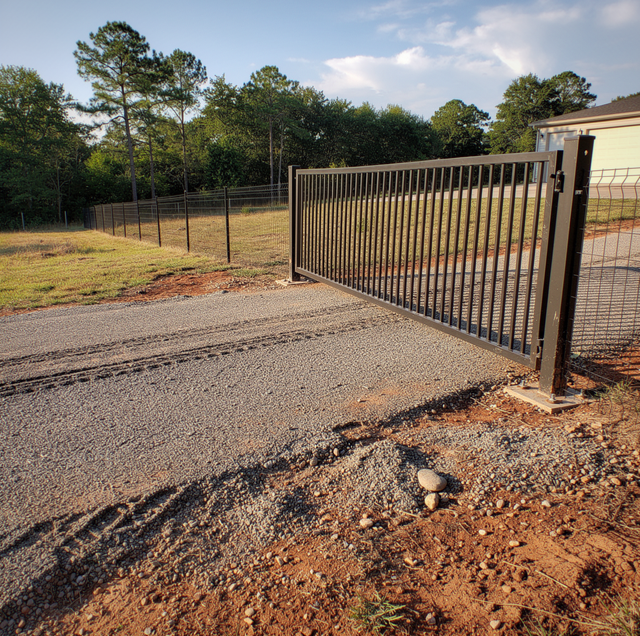
A swing gate turns on hinges, and a slide gate travels along a straight run; which one belongs at a given spot depends on what the ground does there. A swing gate needs the arc's footprint clear at the opening; a slide gate needs a straight run of clear ground along the fence line, or, where there is no ground run at all, a cantilever's setback behind the posts. On a level, wide-open frontage, either geometry works, and the choice comes down to taste. On a sloped drive or a narrow frontage, the ground narrows the choice before taste enters it, and the wrong geometry for that spot shows up as a leaf that drags, sits high, or has no room to open.
Match what the drive does at the opening to the geometry built to handle it:
| What Your Drive Has | Better-Suited Gate | Why |
|---|---|---|
| Drive slopes up from the street | Swing on a gentle rise; slide on a graded flat pad once the rise gets steep | The leaf pivots in place and only has to clear the ground under its own swept arc on a gentle rise, but a leaf hung to clear a steeper one ends up higher than is practical, at which point grading a short level pad for a slide track is the other route. |
| Drive slopes down from the gate | Swing hung to the grade, or slide on a graded flat pad | Ground falling away under the arc opens a gap beneath a swing leaf; a level pad lets a slide leaf run flat. |
| Narrow frontage with no side run | Swing | A swing needs the arc's footprint at the opening, not clear ground down the fence line. |
| Room to the side along the fence line | Slide, rolling or cantilever | The leaf travels along the fence line rather than into the yard, so a wide arc across the drive is unnecessary. |
| Vehicles parked close inside the gate | Slide | A swing leaf opens into that space; a slide leaf travels past it without crossing it. |
| Automation planned | Either, matched to an operator built for that motion | Swing and slide operators perform different motions and are not interchangeable. |
How Each Gate Moves
Swing: a single leaf hinges to one post and pivots through an arc; a double swing splits the same opening into two leaves, each hinged on its own side, meeting at the center when closed.
Rolling slide: the leaf hangs from rollers that ride a track set into the ground or along a curb at the fence line, guided at the top so it stays on the rail instead of drifting off.
Cantilever slide: the leaf rides on rollers mounted to steel posts set back from the opening, with the beam extending inside the fence line to counterbalance the section that hangs out over the drive when open. Nothing runs at ground level, so there is no track to catch a tire or pack with debris.
Slope and the Swing Arc
A swing leaf's low edge traces a curve at a fixed height off its hinge line. When the drive under that arc rises or falls, the ground and the leaf's path no longer match. On a drive that rises toward the gate, the arc sweeps over ground higher than the hinge, so the leaf has to clear the highest point it crosses, not just the ground at the post. On a drive that falls away past the gate, the far end of the arc drops below the leaf, opening a gap under the bottom rail wide enough to matter.
A single leaf spanning a wide opening carries the entire elevation change across a single arc. Splitting the same width into a double swing lets each leaf cross only half the width and roughly half the corresponding rise or fall, which is one reason a wide opening on a graded drive can be built as a double rather than a single long leaf. Past a certain rise, though, hanging a swing leaf high enough to clear the grade the whole way through its arc stops being practical: the leaf sits noticeably above the rest of the fence line when closed, and the hinge hardware carries an awkward angle it was not built for. A slide gate moves the problem from the leaf to the ground: a rolling track needs a level, graded run, and a cantilever needs level clearance under its whole travel.
Side Clearance and the Slide Run (Rolling vs Cantilever)
A rolling gate needs a straight, level run of clear ground beside the opening at least as long as the leaf itself. A leaf spanning most of a narrow frontage requires the same length of open running room next to it, and if the property does not have it, rolling is not an option, regardless of preference.
A cantilever gate needs no ground track, but it needs setback instead: its support posts stand together on the side the leaf retracts to, the frame carries a counterbalance tail beyond the opening, and a receiver post on the far side catches the closed leaf. Those support posts carry the cantilevered load on two footings rather than a distributed track, so they experience more concentrated stress than a rolling gate's end posts do.
Posts, Footings and the Ground Under Them
A gate post carries more than a line post ever does. A swing post absorbs the racking torque from a leaf opening and closing with every cycle, while also holding up the fence beside it. A cantilever post carries the full weight of an open leaf cantilevered off two footings, rather than being spread along a track. A rolling gate's end post anchors one end of a track that has to stay straight for the rollers to run true. Post movement below grade first appears as a gate that binds, drags, or stops at its open or closed position before becoming visible as a lean.
Clay that swells and shrinks through the year can heave a gate post, and each layout feels it at a different place: a swing leaf at its hinge post, a cantilever at its pair of support posts, a rolling gate along the whole ground run its track has to hold in line. Where the soil holds still, none of the three layouts gains or loses on this point, and the choice goes back to slope and side run.
Automation for Each Type
A swing operator mounts near the base of the leaf, either as a straight arm that pushes and pulls the leaf through its entire arc in one continuous motion, or as an articulated arm with an elbow joint that folds as the leaf opens, letting the arm sit closer to the post when closed while still reaching full travel. A slide operator, rolling or cantilever, drives a gear rack mounted along the bottom edge of the leaf with a pinion turned by the motor, so the motor moves the leaf directly along its own path instead of swinging an arm against it.
A moving automatic gate can pin or drag anyone caught between the leaf and a post or vehicle. Keep children and pets clear of the path, and have the installer confirm the safety sensors and edges are active before it runs unattended.
A swing operator works against wind loading the leaf through its arc; a slide operator does not fight that swinging resistance, though a parked slide leaf still loads its posts.
Confirming Fit at the Site Walk
Confirm the frontage has clear ground down the fence line before a slide gets specified: a narrow lot without that run leaves a slide leaf nowhere to go, which points to a single or double swing. Confirm the posts will land on ground able to carry the load path the chosen gate puts on them.
Measure the grade across the whole swept arc or slide run, not just at the gate posts. A drive can look level at the opening and still rise or fall enough partway through the travel to change which gate fits.
On a tight frontage, splitting the opening into a double swing shortens each leaf's arc into the drive, which can be what makes a swing fit where a single long leaf would hit a parked car.
Frequently Asked Questions
Yes. Each leaf in a double swing gets its own hinge line, and its own edge at the opening, and the two edges need a drop rod or ground catch where they meet at center to hold the closed position and keep one leaf from swinging past the other. A single leaf closes against a post instead and does not need a center drop rod to meet a second leaf.
No. The frame has to span the full opening to reach the receiver post, and the counterbalance tail runs past that, so the whole leaf is longer than the opening it closes.
A track set slightly above the surrounding grade, with the ground sloped away from it, keeps standing water and washed-in grit from packing into the roller path. A track set flush with or below grade collects both, and the rollers need clearing before the gate runs freely again.
Yes. A single-wide leaf puts its full weight and entire racking torque on one hinge post. A double gate of the same total width splits that weight and torque across two hinge posts, one on each side of the opening.
Only if the existing footings suit the new load. Swing posts are set to take hinge-side racking load close to the opening; slide posts carry either a straight track run or a cantilever setback and counterbalance load farther back. Converting from one geometry to the other can mean resetting the footings for the new load path, since the original posts were never sized for it.
Yes. A solid panel presents a continuous face to the wind, so operator sizing must account for the wind-load area on top of the panel's weight. A picket or rail-style panel of the same footprint lets wind pass through it and asks less of the same motor.
Ask for a gate layout that fits your drive's slope and side run — single and double swing gates, rolling and cantilever slide gates and their operators, each set on footings sized for the gate it carries. Palacios Construction Group serves Willis, Conroe, and The Woodlands. Call (936) 265-7256.