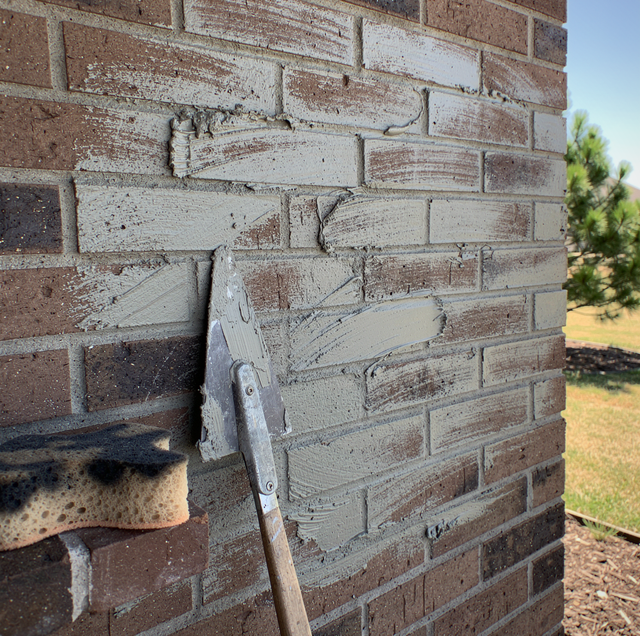
Two finishes end up on the same short list when you want your brick to stop being red, and they're not the same kind of thing. Limewash is a thinned mineral paste that soaks into the face of the brick you already have. German smear is wet mortar, worked across that face with a trowel and knocked back with a sponge before it stiffens.
The difference you are choosing between sits under the color. It comes down to the material itself, the tool that applies it to your wall, and how long you have before the choice becomes irreversible. Once you can name which of the two you are looking at, every single other question about the wall gets easier to answer.
One Is Crushed Limestone and Water, the Other Mortar
Limewash starts as a chalky paste made from crushed limestone and water. It is thin enough to brush, and it sinks deeply into the brick's porous surface, bonding firmly. German smear starts as mortar, the material already in the joints, mixed wet. A paste that soaks in and a mortar that sits on the face cannot age, fail, or come off.
Both stay vapor-open. Limewash is chalky and breathable, which means moisture does not get trapped inside the brick the way it can with certain paints, though the right paint for brick avoids that issue too. The broader argument about coatings trapping water is a different subject.
The Brush, the Sponge, and the Window Between Them
German smear goes on the way a mason works rather than the way a painter does. The wall is wetted down first, then wet mortar is pressed over the brick faces and through the joints with a trowel or a gloved hand and partly wiped back before it stiffens: applied wet over a wet brick or stone wall, then washed back with a wet sponge or hose so the mortar does not completely cover the wall material. A crew can leave a very heavy or a thinner coat of mortar, depending on the desired effect.
Limewash is brushed. A masonry brush loads the paste onto the already-dampened brick, and some of it comes back off with a hose or a wet sponge, so the brick you chose to keep visible shows through again in the proportion you asked for. The tool is different, the consistency differs, and the crew on your wall is watching it lighten where a mason would be watching mortar stiffen.
Wet lime and fresh mortar burn skin and eyes, so both are gloved, eye-protected work for a crew that mixes them weekly and reaches the elevation from a staging setup for the job.
Coverage Runs From a Faint Haze to Full Dimensional Texture
Coverage on a limewash is fixed by how heavily it went on and how much came back off while the wash is still wet. The limewash surface reads as thin, matte, and closely following the masonry texture, against a mortar finish that reads as dimensional, mineral, and visibly hand-worked. A limewashed wall still looks like the wall you already own in a lighter color. A smeared wall looks like a different surface altogether.
Neither level of coverage is a fixed recipe, which is why a sample panel on a low, out-of-the-way stretch of your own brick is the only honest preview available, rather than a photograph of somebody else's house. Two walls given one mix in one hour finish differently when one of them takes more knock-back.
The Removal Window Is the Difference You Cannot Undo
Limewash is the only one of the two with a window at all, and its measurement is in hours. Lime mortar can be removed within 48 hours of application in most cases, whereas limewash becomes very permanent within a couple of days. Together, those two facts put the reversible period at roughly the first two days, after which the wash has calcified onto your brick and is part of it.
German smear has no such window, and the guidance is blunt about it: mortar wash, once it is dry, is extremely difficult to remove, and should be considered a permanent decision. Applying muriatic acid may remove the mortar with a lot of scrubbing, but it is best for the health of the brick to plan on leaving the mortar wash on. That acid option is raised only to be argued against in the same breath, which makes it a point worth reading twice before a sample goes up.
So the two finishes require different levels of certainty before the first bucket is mixed. A limewash that comes out heavier than expected can be washed back or lifted inside the first day or so. A mortar wash that comes out heavier than expected is the wall you now own. This is a permanence choice, not an opacity choice, and the two get confused on the sample board because they arrive looking like one decision with two swatches.
What Each Finish Does to the Mortar Joint Line
The joint line is the detail that gives a finish away from three feet. A mortar finish can fill treated joints and bring them toward the brick face, while limewash generally follows the existing joint profile. A limewashed wall keeps the grid of recessed joints you already have. A smeared wall can lose that grid, because mortar is added into the joints and across the faces at once.
So the joints get looked at first. Where mortar is eroded, cracked, or missing, repointing comes before any finish, and a mortar wash laid over failing joints covers your problem without repairing it. Brick repair and tuckpointing sit alongside specialty finishes in one contractor's scope, which is a scheduling convenience rather than a reason to treat the finish as the repair.
Both Finishes Age, but Not in the Same Way
Different sources describe how long limewash lasts in different words, and both are accurate. Limewash calcifies on the brick walls, then goes through an aging process called patina over time, and can last many years. It is also described as breathable and expected to weather, fade, and require recurring care.
Those are two different clocks. One is the removal window, which closes in days. The other is appearance, which softens across years and is why many owners choose a lime finish at all. No single number of years holds across the trade, and a contractor quoting one should say which clock he means.
The Wall Has to Be Ready Before Either Goes On
One step comes before color, and it is the step most often skipped on an older house. A finish decision begins with the condition of the masonry and the desired long-term behavior, then moves into appearance. Where a neighborhood has an architectural committee, that conversation belongs in the same early week, before a sample panel goes up.
Which leaves a clean way to hold the two apart. One of them changes how much brick you see, and the other changes how long you have left to change your mind.
Frequently Asked Questions
Rain in the first hours acts as an unplanned knock-back and can lighten or streak the coverage you were after, so your crew watches the forecast as closely as the calendar. A cured limewash is quite water-resistant, so your exposure lasts only while the coat you put on is young.
Masking, and a lot of it. Glass, frames, fixtures, and door hardware get taped before a bucket is opened, because lime residue on glass is harder to clean off than to prevent. Shrubs and beds under your wall get covered and wetted down first, since a plant soaked before the runoff arrives sheds material it would otherwise absorb. The crew rinses the ground as it moves along your elevation, so nothing dries where you did not want it.
Both do, and an interior wall is easier because nothing weathers it. A mortar wash indoors, without exposure to the elements, retains its appearance for years, and an interior limewash on a brick fireplace can last almost indefinitely without weathering. Your interior choice is closer to appearance alone than your exterior one, so you pick what you like.
Not without an assessment. Painted brick is not the same working surface as bare masonry; existing coatings can interfere with mortar contact, and conventional paint is not treated as a suitable foundation for an authentic mortar-based application. If your brick was painted at some point, your question becomes what is on your wall now and whether you keep it.
It can, more so under a thin coat. In a mortar wash, thin tonal areas can allow the original brick color to influence the white mortar. A red brick pulls your white warm, which is why you put your sample up on your own wall.
Yes, and drying speed matters more than temperature. Ideally, the wash goes on an overcast day to prevent it from drying faster than intended, and temperature extremes during application are avoided. The reason sits in the method. After the paste is brushed on, the crew waits roughly 30 to 45 minutes before using a hose or wet sponge to take some of it back off so the brick shows through. A wall in full sun skins over before that window arrives, and your coverage lands heavier than the sample you approved.
A walkthrough with Joel puts the two finishes against your actual brick and your actual joints — sample panels go up first on a low elevation before anything commits the whole house, so you see the coverage on your own wall before the rest is mixed. Palacios Construction Group serves Willis, Conroe, and The Woodlands. Call (936) 265-7256.
